Chicago-Area
Albums of the Mid 60s to Early 1970s
Bands
Reviewed: The
American Breed, Aorta,
The
Buckinghams, Chicago,
The
Cryan' Shames, The Flock,
H.P.
Lovecraft,
Illinois Speed Press, The
New Colony Six, The Shadows
of Knight.
Ill-formatted
and Sprawling Timeline of Chicago Bands
The
city of
Chicago was certainly large enough to have its own scene and sound,
like Detroit or San Francisco, but what it had was far weaker. Few of
these bands are remembered today in a flattering way (think of
Chicago's 80s ballads), which is appropriate. Most of them turned to
lame pop even if
they started off with harder sounds (New Colony Six, Chicago, even the
Buckinghams used
to rock). Even though the area had a pile of late 60s pop hits,
these bands were unable to maintain any momentum beyond 1968 or so.
What I am going to call the First Wave bands (The Buckinghams, The
Cryan' Shames, The American Breed) could not adapt to harder
times, and fizzled into pop. Even harder garage bands like
the
Shadows of Knight and New Colony Six sold out within a few years. The
"Chicago Sound," which involving horns and some
more jazzy chords and was pioneered by the Buckinghams on "Kind
of a Drag," became quickly dated. It evolved into the
jazz-rock parts of the more professional sounding Second Wave
(loosely Chicago, the Flock, Illinois Speed Press, Madura), showing up
in the
first two's sound, but otherwise became the MOR sound of the moment.
I
partially
attribute this odd and persistent shift into pop to two influential
producers on the scene - James William Guercio (one-time Chad &
Jeremy bassist) and Bill Traut (one-time jazz saxophonist and law
school graduate). Guercio took over the Buckinghams, and got them
some hits but also ran them into the ground with his awful
arrangements and songs. With the subsequent explosion of White Horn
Rock at the tail end of the 60s, Guercio became famous for producing
both Chicago and Blood, Sweat & Tears. Traut is less known. He
originally made it big with the Shadows of Knight, which he recorded
in their own instrumental squalor. But after the Buckinghams vaulted
up the charts, Traut and pianist/arranger Eddie Higgins were soon
clogging pop albums with horns and strings, burying their bands'
skills. The American Breed typifies this - they had no opportunities
to really display their talents (assuming they had some) but still
scored some hits with songs like "Bend Me Shape Me" before
cratering within the next few years. (Other bands like the New Colony
Six crippled themselves with horns). Traut's bands also seemed to
rely on outside sources for songwriting, with ugly results. Still
later, Traut introduced Styx to the world, which is like being a
demon's midwife.
It's
not so
simple, certainly. Traut produced just about anything he could
(including the Nazz's debut!), and the Chicago area did have some
interesting bands. Both H.P. Lovecraft and Aorta had some extra
flourishes, but were primarily psychedelic bands. Also, other bands
ventured outside the Chicago Sound - Illinois Speed Press, Mason
Proffit and Wilderness Road were more country oriented, while
Siegel-Schwall was almost a straight blues band and Madura seems to
have been more progressive. Certainly Chicago had a thriving jazz and
blues scene as well, and down at Chess studios, they were producing
soul-pop-?-rock with Rotary Connection. Also interesting is that
there is a fair amount of movement between some of these bands for
people, especially with Traut connected-bands. In the end, the entire
Chicago scene and "Sound" was mediocre, and neither as
popular or influential as others.
Albums
which I can recommend
-
Aorta
(cool psychedelic rock)
The Cryan' Shames - A
Scratch in the Sky (Chicago boys try a more diverse,
Beatles-like
approach)
Chicago
Transit Authority (jazz-rock
back when Chicago still rocked)
The
Flock
(jazz-rock led by an amazing violin player)
The
American Breed
Chicago pop group in the hands of ...wait
for it...
Aorta, H.P. Lovecraft, Shadows of Knight, Styx producer Bill Traut.
They evolved into Rufus (featuring Chaka Khan).
American
Breed
(1967)
A highly
non-politically correct cover graced this album.
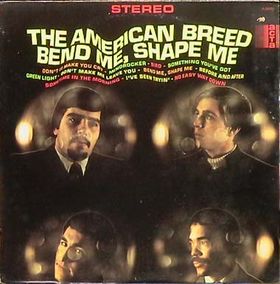 Bend
Me Shape Me (1968),
*1/2
Bend
Me Shape Me (1968),
*1/2
One-hit wonders, the title track has everything
you could want from the "Chicago Sound": big horns, handclaps, a catchy
chord progression and a
danceable beat. It could have been re-mixed for the disco era
and succeeded. The only other decent number is the driving
"Green Light" written by Annette Tucker, who was behind
most of The Electric Prunes' I
Had Too Much to Dream Last Night.
Beyond that ...it gets ugly. Slower, bland pop,
mostly by anonymous songwriters fill out the rest, although
there are a couple of real dogs from the Goffin-King duo ("Sometime
in the Morning" and "No Easy Way Down" which involves
toy balloons). The band's two contributions ("Don't It
Make You Cry" and "Bird") are just as bland, with the
latter featuring a pitiful guitar solo break. But at least it
has audible guitar; producer Bill Traut consigned the guitar
to the background as usual, layering on horns or
strings, and focusing on the vocals. The fault with that
strategy was that Gary Loizzo was not
a strong lead vocalist, and so the Breed does a lot of
just-alright group vocals or using overdubs. Maybe the fact
that Loizzo
was their "lead guitarist" has something to do with their lack
of
lead guitar. This is one of those groups where the fact that
a
member had a voice seems more important than their actual playing
skills. Heck, drummer Lee Grazanio may have earned some extra
dough by playing trumpet with the horn section. Actually,
rhythm in general is their strong suit - it's just that the songs are
junk.
Not to say the band lacks any trace of
personality; the production subsumes them like on
Buckinghams records:
the guitars are buried, and horns or strings are
often given as much importance as the band's playing. The
Breed's playing or singing is not as good as the Bucks',
however. The Breed drew more on soul and old fashioned
50s
R&B than other Chicago groups did ("Something You've Got"),
and they do cover Curtis Mayfield's "I've Been Tryin'",
which I cannot picture many other Chicago groups doing. They
were also
integrated, a rarity, with an African American bassist in Chuck
Colbern (or Colbert). All interesting, but none of it changes
the fact that this music is icky pap. Take the two good
tracks
(the title track and "Green Light") and run. The band
is Loizzo (lead guitar/vocals), Al Ciner (rhythm guitar), Lee
Grazanio (drums/trumpet), and Chuck Colbern (bass).
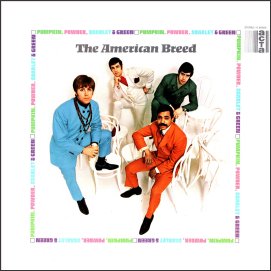 Pumpkin
Powder Scarlet and Green (1968),
*1/2
Pumpkin
Powder Scarlet and Green (1968),
*1/2
All
the crap of the prior album without the hits, and with
marginally improved sound and a lame attempt at a concept (the
title refers to the suits worn by band members on the cover and brief
tracks that bookend each side of the album). No "Bend Me
Shape Me" balances things out here. The album does give us
some good news - rhythm guitarist Al Ciner shaved off his bad
mustache and beard and looks like he lost some weight.
Bassist
Chuck Colbert's mustache is still large enough to look fake, however.
To be fair, the Breed still does an excellent job on the rhythm front
- they just need songs that aren't second-rate cliché-fests
and a good vocalist. At least they didn't lose it all, and
turn
completely lame-o like the New
Colony Six.
I mean, what the heck happened to those
guys?
Produced by Bill Traut again.
POINTLESS THOUGHTS: I thought it would be
more interesting to look at
the songwriters responsible for these tracks, but it was taking way
too long. I'll just make a few comments, since I don't normally deal
with professional songwriters. My rudimentary understanding of how
the business worked is this: songwriters, usually working for a
publishing company, recorded demos of their songs. These
demos
would often be just guitar or piano with one voice. The publisher
would then send these out to interested people (record producers) in
the hopes that they would record it, and both the writer and the
company would make money. Not all professional songwriters
were
bad, although the field is littered with hacks. Most of
Motown's catalog was written by songwriting teams, and songwriters
are responsible for a great portion of pop. Sometimes they had enough
talent to become performers - Carole King is the quintessential
example, although Lou Reed qualifies as well.
Veterans
wrote most of the songs on this album, which does not make the songs
less bad. The guy who wrote "Under the Boardwalk"
collaborates with the person responsible for Barry Manilow's "Mandy,"
to make "Cool It (We're Not Alone)." Chip Taylor may be
famous for writing "Wild Thing," but not for "Anyway
That You Want Me" on this album. My point is that songwriting
appears to be hit or miss if you are the songwriter. Too much is
outside of your hands - the artist's talent, the production, the
marketing. Some of these people have hundreds of songs registered,
although you may only recognize a couple. I think there may be too
much of a disconnect to have a real steady stream for many
songwriters, unless they are part of a large stable system like
Motown. If you are in a band, or are a solo artist, you have a say on
how your idea is actually presented. Otherwise, if you have some
innate talent like Carole King, it may not show up when presented by
a band like the American Breed. Instead, it will blend into a song
("Welcome, You're in Love") by a guy with a recurring role
on the Rockford Files (Stuart Margolin). There are good songwriters
(or just good songs), but beyond them it falls on the talent of the
band.
Lonely
Side of the
City (1968)
Three
albums in one year, huh. I'm sure this is high
quality
stuff.
Aorta
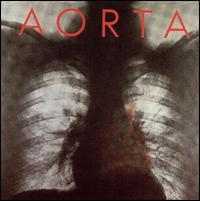 Aorta
(Mar.
1969), ****
Aorta
(Mar.
1969), ****
An attempt to cram all of psychedelic pop from Sgt. Peppers onward
into one album, with great results, OR: English-influenced psychedelia
seen through a
Chicago pop lens - i.e., rock with strong pop leanings and orchestral
overdubs. Aorta
has a laundry list of
psychedelia:
Strange repeating linking tracks? Check: four separate tracks
called "Main Vein", which repeat the phrase "Have
you ever wondered what it is? It's your main vein."
Tracks all run together? Check. Strange sound
collages?
Check. Buzzy psychedelic guitar? Check.
Bizarre
drug-induced lyrics? Check. Aorta
does some of these things very well. Pop song with lush
orchestration? Try "Sprinkle Road to Cork Street."
Guitarist Jim Donlinger's trippy electric
guitar lines
songs like "Heart Attack", "Ode
to Missy Mxyzosptlk" or "Strange". The other songwriter,
keyboardist
Jim Nyeholt, sticks mainly to organ, and takes advantage of
the mid-fi
sound to vary the band's sound through cathedral organ ("Sleep Tight"),
electric piano, as well as
orchestrating several tracks.
The pop-leaning psychedelia
works often, as on "Magic Bed," a delightful romp through whacked
out dreams, and "Strange" certainly reflects the Chicago
heritage, featuring belted-out vocal harmonies and lyrics about
"proving I'm a man," balanced by Donlinger's wily guitar. As
noted Donlinger's fluid guitar and tone drive the harder tracks to
success - the panting before "Heart
Attack" is nice touch to a burning meteor of a song,
and "What's In My Mind's Eye" with a blippy Eastern flair,
among
them. Trouble arises in the "Main Vein"
tracks, and an anemic lounge song (which might be a
parody) lies
closer to Chicago ("A
Thousand Thoughts"). Also attractive are the jazzy
underpinnings found in "Ode to Missy Mxyzosptlk" and
Donlinger's solo section in "Strange," although not
surprising (or strange) given that this was the band from which Peter
Cetera
joined Chicago.
(His replacement, Bobby Jones, does a fine job.)
Yet, despite all the
psychedelic bells and whistles, this was a Donlinger/Bill Traut
co-production and sounds like it. Aorta
retains some of the bad characteristgics of Chicago
pop: Herman's
drums are indifferently recorded and mixed (dumped in the
center), and Nyeholt's
orchestrations can resemble a pop producer's add-on ("A
Thousand Thoughts" sounds like the Moody Blues' leavings).
But while diversity
is often important with psychedelia, Aorta
has
a lot of ideas (often second-hand ones) and succeeds more than not.
Maybe I listen to too much bad music, but this album has
really
grown on me: it's catchy and diverse and well-played. A better sibling to Scratch in the Sky.
Columbia released the
album at roughly the same time as Chicago
Transit Authority, The
Flock, and Illinois
Speed Press
in
mid-1969 to push a "Chicago" sound.
However, all the copyright dates are from 1968 in the album, indicating
it
might have sat for some months. Herman joined a declining New
Colony Six.
Donlinger and Nyeholt joined soul band Rotary Connection for
a
bit (or exchanged members with them?), then re-established Aorta with a
couple members of that group. They also guested (or were
members)
of the band Coven on their debut album. It's your main vein.
 Aorta
2 (1970), **
Aorta
2 (1970), **
New lineup (bassist/singer Michael Been and Donliger brother
Tom on drums) and Aorta's sound has been re-jiggered and is
far less ambitious. It sounds like bassist/singer
Michael Been was the main figure in this incarnation of the band, and
his schtick is different and somewhat dated: his white soul vocals with
the band's sound patched
together from the hits of 1969 - CS&N, The Band,
even Chicago (the percussion in
"Egypt"). At its core, the band clearly has talent and can be
soul/jazz groove machine ("His Faith in Man", "Little
Bonnie"), but the new direction undercuts this. Donlinger's
lead guitar and Nyholt's keyboards
have less to do, and Been singing about End Times, for
real ("Beg for His Forgiveness"). But at least they
pair the more on-the-nose song titles with some good performances: "Beg
for His Forgiveness" is one of the few places where Donlinger's guitar
shines, but "His Faith in Man" or the sub-The Band "Devil, Maggot
&
Son". Maybe it's just me, but an attempt to make a
cool psychedelic
album is infintely more interesting than a The Band knockoff with
occasional Christian lyrics. A change with the times, but I
am not surprised the band broke up after this album.
Been and Donlinger joined Lovecraft, and the former
now
goes by the name of James
Vincent. Been achieved success with The Call in the
80s.
Chicago
 Chicago
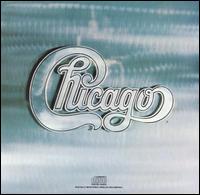
Transit Authority (Apr. 1969),
***1/2
Chicago
Transit Authority (Apr. 1969),
***1/2
Wait
a minute,
Chicago? You mean the group who did those overwrought
annoying
ballads in the eighties? Yes, but let us not forget their
brief
string of success in the late sixties and early seventies, before
they became soft rock schlockmeisters. A good portion of that
aforementioned success came from their self titled first album, which
mixed various styles in most songs. They formed around the
same
time as Blood, Sweat and Tears,
but didn't record
until after that group made it big with the horn sound. Not
surprisingly, James Guercio, who produced BS&T, produced this
album as well, which rocks harder than expected. The big hits
are all here - "Does Anybody Really Know What Time It is?",
"Introduction," "Beginnings," and the rest of the
tracks are equally as good, which is a real surprise for a double
debut album. Equally unusual is the lack of cover material -
limited only to an OK rendition of the Spencer Davis Group's "I'm
a Man". The weak moments are guitarist Terry Kath's
experimental instrumental "Free Form Guitar" (name says it
all), and the fourteen+ minute instrumental live track "Liberation,"
which demonstrates that the band really could play well live, but
Kath's guitar gets a little tiring after awhile. Robert Lamm
(keyboards) was the dominant songwriter, picking up half the
tracks.
But the group really has their stuff down - the rhythm section of
Daniel Seraphine (drums) and Peter Cetera (bass) are top notch, and
Kath shows that American guitarists can play loud and well (the
opening of "Questions 67 and 68"). The horn section
is James Pankow (trombone), Walter Parazaider (woodwinds) and Lee
Loughnane (trumpet).
 Chicago
II (Jan. 1970),
***
Chicago
II (Jan. 1970),
***
After
their first album Chicago decided they did not want to be a rock band
after all - they wanted to be a soft rock band. Consequently,
the members' parts are more equal, with the horns everywhere, no real
long instrumental passages and Kath's guitar has been
muzzled.
They get softer (example - light flute solos), but they tend to
experiment a lot, which is not always a good thing. The
result
is that they play around with the time signature a bit, add in a fake
Sell
Out style
needle skip, and have a Pankow-written ballad (consisting of six
tracks), a Kath written orchestrated piece (with four), and the
hideous political crap that is "It Better End Soon" in no
less then four "movements." In case you did not think
they were pretentious, they also add a "u" to the word
"color." That being said, some of it is good, some of
it is bad, but overall you can still listen to it. The
opening
jazzy numbers, "Movin' On" and "The Road," make
these stylistic changes work, and even some overtly pop works like
"Make Me Smile" and the 70s prom favorite "Colour My
World" have a certain charm. On the second half, "Fancy
Colours" is 3/4 fun and "25 or 6 to 4" is the only
time Kath lets loose. The album's closer "Where Do We Go
From Here," itself good, makes you want to answer "Anyplace
but this annoying soft-rock hell you seem bent on creating."
Otherwise Chicago
II is
filler galore! Interesting to note that the writing has
really
been split amongst the group, vs. the Lamm-dominated debut.
Lineup remains the same. They
got sued real quick by the real C.T.A., hence the name change to
Chicago.
I
have some of their
albums past this and I can summarize them real quickly: Crap.
Illinois
Speed Press
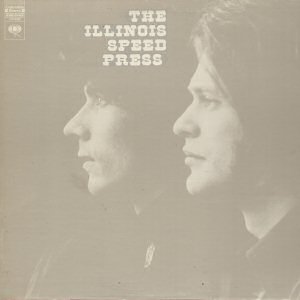 Illinois
Speed Press (1969),
***
Illinois
Speed Press (1969),
***
Most
midwestern cities have lots of bars, and on any night a good portion
of them are filled with bands. Not especially good bands, often
background music for carrousing, who'll play over clinking bottles,
chatter and bad lighting. Recording equipment is ubiquitous enough
today that almost anyone can release a CD, even if it consists of
lazy Led Zeppelin or Pink Floyd covers. Most will never make it out
of this circle, and many will never try.
I
don't know if Illinois Speed Press was a bar band, but they sound
like a good one. History shows that James William Guercio forced
Columbia to signed every band containing a member of the defunct
Chicago outfit the Exceptions: Chicago (Peter Cetera), Aorta (half
the band), and the Buckinghams (Marty Grebb), so slot in ISP there as
well. Fronted by singer/guitarists
Kal David (the ex-Exception) and Paul Cotton,
ISP
is what you expect from the Heartland of America - blues-rock and
sensitive-70s-mustache man music. I once drove through most of
Illinois at night and the radio was filled with this stuff -
precursors to early REO Speedwagon, crappy soft-rock et cetera. Few
pretentions, just regular rock.
ISP's
sound centers around David and Cotton's buzzed-up guitars (Michael
Anthony's organ less so). One of the singers (David?) also sounds
exactly like one of the Chicago singers (Lamm?) and ISP's blues often
resembles Chicago's approach (the obvious single "Get in the
Wind", "Hard Luck Story"). The Chicago sound isn't
that surprising, but the organ and distorted guitars also bring to
mind a straight-edge Iron Butterfly ("Get in the Wind "),
oddly enough. Guercio didn't crap up the production for once, and
ISP
has
no horns,
scant psychedelia, and well-placed overdubs. "Overture" is
the exception, the genius producer pasted various instrument tracks
together to be arty and annoying.
Just
being a blues-rock bar
band dumped in
a studio would earn them little on these pages, and what
makes
the band of any interest is that they did the little things right.
The buzzed up dual lead guitar works ("Be a Woman", "Free
Ride", or "Beauty"), elevating them above mere bar
bands. The rhythm section put little quirks in from time to time.
Cotton's post-Springfield
songs are also not rote; "Here Today"
would be a standard acoustic countrified song, except that the bass
line is the lead. The lyrics aren't much but if you're listening to
blues-rock for lyrics beyond "women" complaints or tales,
good luck. ISP was a group of guys making music they liked, and they
were better at it than most.
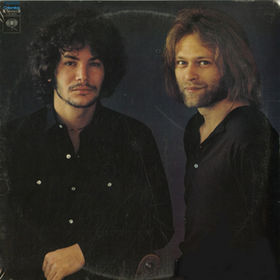 Illinois
Speed Press: Duet (1970),
**
Illinois
Speed Press: Duet (1970),
**
Sometimes
on the
interminable journey in the backwaters of popular music, I curse
myself for undertaking this Quixotic journey. I forget what good
music sounds like. I speculate as to why and how various recordings
were made, ones whose only value is contained in its format (old
beat-up LP -> $ nothing). The easy way out is to unleash hate,
and I've done that from time to time. But, hell, I can't hate
Illinois Speed Press. I understand why this record exists, even if
its value is something like those poor imitation mid-century
saltshakers that haunt antique shows - cheaper, but still with some
talent. The Press, now just David and Cotton, had talent in
their guitar skills, but lacked a songwriter who could do more
than say hey! blues-rock! or hey! country-rock! and slap down some
guitar. Duet stepped
away from the bar band sound (strings, backing, etc) but it is easy
enough to picture the Press dudes in the blue jeans and dark shirts,
letting it all come out in a club somewhere (maybe with a backing
band). ISP sound like they could entertain an audience with the two
guitars in blues/country mode, but in recorded form they sound like
warmed-over ideas. David had the better ear, but that isn't saying
much: "The Visit" is the album's sharpest track, a sort of
soul big-band blues track, while his others songs are either
blues-rock "The One Who Knows" or country/soft-rock "The
One Who Knows". Cotton's work is more of the same, excepting
the Chicago II-style
orchestrated "Dearly" suite, whose
"Bittersweet" part is good in a sub-Ritchie Furay manner. They lacked a
distinct identity - the "woman" based songs
and their middling output placing them in an orbit between Poco and
the Allman Brothers. Not too hard and not too distinct, Duet
is an album for
those who wanted their blues
and country in an easily digestible package, and was the Press's end.
Cotton joined Poco (a struggle upwards), and David showed up in the
Fabulous Rhinestones.
The New
Colony Six
I
have read only one real tale about the New Colony Six, but it's a
classic: fresh out of high school, and armed with new Revolutionary
outfits, the NC6 decided they were going to try and make it big. They
moved to California, where (to their horror) they discovered another
band in their building, also with Revolutionary style uniforms.
Despite the Twighlight Zone feel of this, the band continued on,
playing only a handful of shows before returning to Chicago,
determined to write their own material like the other band. Their
neighbors? Paul Revere and the Raiders. The NC6 then self-released a
couple of albums: Breakthrough,
which has a strong
reputation
as fuzzy garage rock, and Colonization,
which contains the
minor hit of
"Love You So Much." After that, things went dizzily
downhill as the group embraced lame pop, like almost every other
Chicago group.
Lineup:
Patrick McBride
(vocals), Raymond
Graffia Jr. (vocals), Gerald
Van Kollenburg (guitar), Walter Kemp (bass), Craig Kemp (organ), Chic James (drums). Craig Kemp left in
1966, replaced by Ronnie
Rice (vocals, organ, guitar). Walt Kemp gone in
1967, and Les Kummel
took over on bass (with an interlude of Ellery Temple). Graffia
and James
left 1969, and the band picked up Bill Herman (drums),
Chuck Jobes
(keyboards), Bruce Gordon
(guitar). McBride
left 1970. More changes after that, as Van Kollenburg was the only original member until the end in 1974.
 Breakthrough!
(June 1966), **1/2
Breakthrough!
(June 1966), **1/2
These guys were still in high school at this
point I think, and this is
fine with that caveat. It's almost uniformly decent album: a
dumpy recording of a good band playing British Invasion music.
It's not really garage rock, although some of the sonic
elements
are there: a good rhythm section, cheap organ, not particularly gifted
singers, cruddy guitar. The last two would hobble the band
later
on, and they already show a good interest in vocal harmonies ("Dawn Is
Breaking"). At this point when they slow things down the
reverbed
guitar and organ help create a pensive mood (Graffia's "The Time of the
Year Is Sunset"). The band didn't really have much of an edge
(or
the "one big room" style of recording killed it), nor is their
songwriting rarely more than pedestrian; their best track is the
opener, "I Confess" with its emotionless vocals. They do have
a
surprising interest in the Yardbirds, covering both "Mister You're a
Better Man Than I" (where Van Kollenburg's guitar leads skate the
Mendoza Line) and Wally Kemp's Yardbirds knockoff, "At the River's Edge".
The album ends with a fake live performance of "Sloopy" which
is
pretty funny in retrospect. The band wrote most of these
songs
(credits spread between combinations of McBride, Kemp and Graffia),
which is something.
None of
this particularly bad, and the album is contemporary of The
Buckinghams' Kind of a
Drag and The Cryan' Shames' Sugar
and Spice, none of which are great (and of which the Buckinghams'
album is probably the strongest).
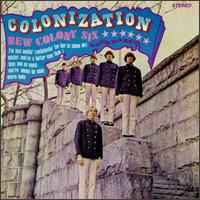 Colonization
(June 1967), **
Colonization
(June 1967), **
By Colonization,
the band had lost its organist, replacement Ronnie Rice was a sugar
pill,
and their weak points are even more obvious - "lead" guitarist Van
Kollenberg is at best a rhythm player, only one of their singers is
any good, and the band's own material was becoming all smiles and no
substance. Unlike their later albums, Colonization
has
plenty of
guitar, and they even get fuzzed up at some points. The best track,
"Let Me Love You," demonstrates this transition from garage
to candy store: tough and fuzzy, with almost forceful versus, and a
light and pleasant bridge. Their attempt at a big feedback freak-out,
a cover of the Yardbirds' "Mr. You're a Better Man than I,"
is largely a flop; Van Kollenberg's fuzzed incompetence is still
incompetence, and their serious rendition of the lyrics is a bit
overboard. Still, I'll take that over the milquetoast,
sub-Byrds/Rubber
Soul balladry
which comprises the album's bulk. Their vocal harmonies are nice, but
sometimes nauseatingly sincere ("Hello, Lonely", "Accept
My Ring"). Colonization
does
have a nod
towards the Buckinghams'
nascent
Chicago sound, "I'm Just Waintin' (Anticipatin' For Her to Show
Up)," co-written by Tony Orlando, pointing to future
overproduction. Balancing teenage pop and
rock is tough, and they do get it correct occasionally ("I Love You So
Much"). Sure, people needed to excuses to dance, but this music
was disposable even before the vinyl cooled. It only got worse from
here. Self-produced, and self-released.
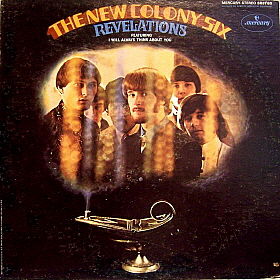 Revelations
(June 1968), *1/2
Revelations
(June 1968), *1/2
By
the time
they recorded Revelations,
the Six had little garage or
rock left in them. Almost every track gets the same treatment - band
quashed into one side, vocals front and center, and obnoxious horns
compliments of Eddie Higgins
on the other
side. Ballads dominate Revelations,
two of which were substantial hits for the Six ("I Will Always
Think About You" which is sentimental dreck, and the marginally
better "Things I'd Like to Say" which has some decent
rhythm playing). These guys sound like they really want to be The
Association, or a substance-less pop band (all of which were
commercially dying at this point, I hope), except the Six lack
strong vocal harmonies or even use them often ("Girl Unsigned"
is the most complex, and it pales in comparison to the Cryan'
Shames). The lyrics are not interesting, including a couple
attempts at harmless humor (the ode to handymen "Dandy Handy
Man" and the pseudo-country "Just Feel Worse").
Otherwise, the songs could be The Readers' Digest versions of bad teen
novels, with titles like "Hold Me With Your Eyes" (yuck!),
"Summertime's Another Name for Love" and "Can't You
See Me Cry." One minor slip of substance is "You Know
Better," which is what the singer's girlfriend says to him in
bed! The entire album has aged poorly, although "Treat Her
Groovy" is the nadir, functioning as some sort of social
guidance PSA (irony miners take note). Neither Ronnie Rice
(sometime lead vocalist), Ray Graffia or Pat McBride have more than
average voices, and the rest of the band does not do much. They wrote
all these tracks, which makes them less phony than the American
Breed, and with competent vocalists, but more wussy. Also, there were seven guys in the NC6.
Produced by Pete Wright.
Take
note of the picture on the back the album if you have it.
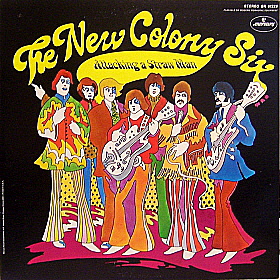 Attacking
a Straw Man (Oct.
1969),
**
Attacking
a Straw Man (Oct.
1969),
**
An
improvement, as former Aortadrummer/vocalist
Billy Herman replaced James. Herman
immediately
became their best musician and singer, and co-wrote a fair number of
songs with Chuck Jobes. You would be surprised how much difference a
steady rock beat can make, as Herman tried to drum respectability
into the Six. Wright's production has taken a turn for the better as
well - more restrained orchestration replace Higgins' overblown ones,
and Wright focuses the mix on Herman, Jobes and Kummel (all
of whom had played in other bands, I note). Graffia, who quit around
this
time, and McBride are still adequate singers who write, while "lead
guitarist" Jerry Van Kollenberg remains incompetent ("Come
and Give Your Love to Me"). Also, yes, Ronnie Rice,
whose syrupy sounds graced the Colony's hit ballads, is still downright
nauseating ("I Want You to Know" and "I
Could Never Lie to You" are the annoying ballad singles).
The
Six's final album incorporates the Chicago area jazz-rock sound, but
the band regretfully plays like it was 1967, despite the rock musician
influx. Jobes can play jazzy chords, Herman can play to
his heart's content, but the band's adventurousness
quotient rose
only slightly ("Ride the Wicked Wind" has some
vaguely gospel-like vocals, and even counter vocals). They were still
way too light and behind the times, as were a lot of harmony bands
("Barbara, I Love You", Jobes'
pleasant but unremarkable "Love, That's the Best I Can Do"
is almost a show-tune). To put this in perspective, Chicago
Transit Authority was released before this album, along with Aorta
and
The
Flock.
Even their "rock" music is more "crappy pop with a
cool beat" ("Come and Give Your Love to Me", "Sun
within You"). Attacking
a Straw Man has all the era's conceits
--a throwback song with a classical motif ("Blue Eyes" with
Rice - that's so 1967,
guys), and the obligatory let's-be-goofy! track ("Come Away With
You"). Plus, the album cover is pop-art
for
chrissakes.
The Who did that back in 19 freaking 66! Better still, it is
the band
photo from Revelations'
back, colored, with Herman and some instruments added. Thanks for
being cheap, Mercury Records. The album finally craters on "Prairie
Gray," a poem read by McBride about a young man leaving home,
with ridiculous backing vocals ("I'm on my way to
Boston...Prairie Graaaaay") and the horns play a riff which
sounds suspiciously like a news program theme. Way too many divergent
directions here - lame Association group pop, icky ballads, and only
partially successful pop/rock. The infusion was too little, too late,
although you can always listen to Herman's drumming, which may be
second only to the Buckingham's Jon-Jon in the local pop
scene.
The band kicked around for FIVE
MORE YEARS releasing
singles, although this is the last album they released.
The Shadows of Knight
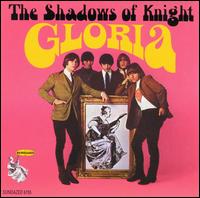 Shadows
of Knight, Gloria
(Apr. 1966),
**1/2
Shadows
of Knight, Gloria
(Apr. 1966),
**1/2
I never used to frequent places like this
coffeeshop that had a jukebox full of sixties
R&B.
It had trashy, fairly trendy stuff - full of attitude and perfect as
background music, but utterly disposable and the songs were only
barely distinguishable from each other. The Shadows of
Knight,
one of Chicago's contributions to the R&B scene, could very
easily have
been on that style-over-substance jukebox, even though the band had a
fair amount of substance. Gloria
is
mainly R&B and blues covers, all done in a style that is a
little
too polished and well-performed to be considered garage (although
there is some dirty fuzz-tone on "It Always Happens That
Way").
Producer Bill Traut's elementary production serves them
well, limiting them to a basic sound.
(Remarkably, he avoided buttering up the album with horns). Their
big hit was their version of the title track, a song by the Irish band
Them. Reportedly, someone
remarked to Traut that Them's original version would have been a hit
if it were not for objectionable lyrics. Traut had the group
record it with those lyrics changed, and presto!
a
big hit.
Those who love mid sixties R&B with guitar to spare will love
this, but for everyone else it will seem only like a spunky local
group playing the R&B songbook ("I Got My Mojo Working",
"Boom Boom", "Hoochie Coochie Man").
Wisely, they save the big number for the end: the frantic "I
Wanna Make Love to You" which is a nice Who-inspired number with
a moment of nice bass-work, some Townshend-like feedback.
Their lead guitarist has all the standard blues moves down for the day,
and
the band sounds like they could whip up a frenzy live, but who wants
to hear the 4939th interpretation of "I Got My Mojo Working?"