Soft Machine
Albums reviewed on this page: Jet
Propelled Photographs, Soft Machine, Volume
Two, Third, Fourth, Matching
Mole.
The Soft Machine were the first group to emerge out of The Wilde
Flowers, a Canterbury band who practically produced the whole
Canterbury subset of art-rock (the remainder of the band coalesced
into Caravan in 1968). The Soft Machine formed in 1966 out of
musicians that were or had been in the Wilde Flowers. A set of
demos recorded the next year show an intriguing direction - a
collection of jazz-pop songs that are faintly reminiscent of the
Zombies - but with more rock and focus on the drums as the real lead
instrument (vs. the Zombies' vocal and keyboard base).
Guitarist Daevid Allen contributed little, but it was apparent that
Robert Wyatt was a top-notch drummer among the likes of Michael Giles
of King Crimson. Allen left before the first album Soft
Machine was recorded, and Kevin Ayers departed afterwards for an
eclectic solo career. He was replaced by Hugh Hopper, another
Wilde Flowers alum. At this point their music was a mixture of
psychedelia, avant-garde, jazz and rock. Got that? Not to
mention the goofy (some would say dadist) sense of humor present
through all of their work. Their Third album was the
last with vocals (limited to one side of a double album), and Wyatt
departed after their Fourth. He soon established
Matching Mole and then went onto an interesting solo career, which
was sadly limited by an accident which left him paralyzed from the
legs down. From then on Soft Machine was fusion group with
various people coming in and out and soldiered on until the early
1980s. So here's the deal - Wyatt is awesome, both as a singer and a
drummer. Ratledge coaxes unusual sounds out of his organ (even
approaching Keith Emerson territory) and Hopper plays a mean fuzz
bass. When Elton Dean joined the group their sound went heavily
towards traditional jazz, and I mean heavily. I'm not the
greatest fan of Dean's playing, but he impressed Reg Dwight enough to
change his first name to Elton. I have Matching Mole's (a
phrase close to the French translation of Soft Machine) first album
as well as a Caravan album. In brief, both group expanded on early
Soft Machine, with Caravan being more pop oriented, and both group
tend to get dragged down by overlong jams.
Recently there have been an awful lot of live albums, and other
odd stuff concerning this period of Soft Machine coming out on CD.
I haven't really had the opportunity to hear any of it, as it hasn't
shown up used around here. Investigate elsewhere.
Personnel: Robert Wyatt (drums, vocals); Daevid Allen (guitar); Mike Ratledge (piano and
organ); and Kevin Ayers (bass). Visa problems forced Allen to leave problems their
first album; he helmed Gong in its various forms.
Ayers left after Soft Machine and was replaced by Hugh
Hopper (bass, occasional sax). The Third lineup
included: Elton Dean (alto sax), Lyn Dobson
(flute, sop. sax), Nick Evans (trombone), Jimmy Hastings
(flute, bass clarinet), of which only Dean was the only one to
stay on. Wyatt left after Fourth. Further changes beyond.
Soft Machine: Jet
Propelled Photographs (rec. Apr 1967), ***1/2
An interesting
session, Jet Propelled Photographs is a collection of flawed jazz-pop songs
enthusiastically performed. The
album's sound and
production is slightly rough (backing vocals on "Save
Yourself"), and Wyatt's voice sounds a touch haggard. At this
point, the group was still a quartet including Daevid Allen; he tends
to
stay in the background, or play unhelpful bluesy lines (his "Town
Without a Pity" intro to "Memories").
Still, you can hear the basis for their future sound in Wyatt's
drumming ("I Should've Known" where he drowns out Allen)
and Ratledge's keyboard parts (the piano and vocal "That's How
Much I Need You Now"). Wyatt also has some great skat
vocals throughout (example: title track). Fans of the early
Soft Machine will love this, and many of these songs appeared amidst
Wyatt's side of Third. Produced by Giorgio Gomelsky,
known for his work with the Rolling Stones and Yardbirds.
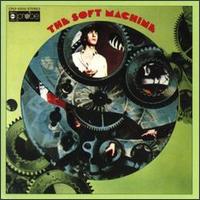 Soft
Machine (1968), ***
Soft
Machine (1968), ***
Sharing a
manager with Jimi Hendrix, the Soft Machine toured with the Experience
in America, and recorded this album in New York. The group
expanded the jazz-rock sound of their demos with
experimental tendencies, but the album's production is a large
mistake. It sounds like producers Chas Chandler and Tom Wilson
treated them as a heavy psychedelic trio - reverb and general
muddiness, few instrumental overdubs or change of instruments.
Since the songs flow well, I would guess the the band went into
the studio and recorded their live act quickly, to give people
something to buy on/after the tour.
The band's thrust was their jazzy songs, now bulked up with Ratledge's quick organ (everywhere, but especially "So Boot If At
All") and
Wyatt's jazzy drumming. Some of the poppier songs lack the
long instrumental
passages in the middle (the serene "A Certain Kind", "Save Yourself"),
but most flow into and out of Ratledge's flights. The band has a
strong sense of humor, seen on "Why Am I So
Short?", while some of the more avant-garde tracks like Ayers' "We Did
It Again" and "Why Are We Sleeping?" are boring. Getting used to
the album's lack of guitar may take a few tries (Wyatt's
drums fill out the sound to an extent), but the monotonous
production
kills the album's life.
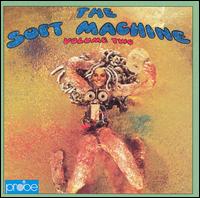 Soft
Machine: Volume Two (1969), ****
Soft
Machine: Volume Two (1969), ****
Immensely
better, and the place to start with the band. The band's sonic
palate expanded
radically, and lyrically they retained the same entertaining patter and
nonsense. Ayers quit, and
Hugh Hopper's fuzzy bass tone made that instrument as distinctive as
the other instruments. Ratledge uses piano and organ, Hopper and
his brother
contribute some saxophone lines, and Wyatt even uses an acoustic guitar
on one song - allowing the band to explore quieter moods, and lacking
the long instrumental passages of the debut. The first half flows
more than the second, but the entire album has plenty of difficult
and/or syncopated rhythms.
The band's dada sense of humor is in full force - a pataphysical
introduction to the alphabet, an ode to the Jimi Hendrix
Experience ("Have You Ever Bean Green?"), a song in Spanish ("Dada Was
Here") with only a few dips into psychedelic nonsense ("Out of
Tunes", "Fire Engine Passing with Bells Clanging" despite its
delightful painting-like title). They even re-write Ayers' "Why
Are We Sleeping?" into an ode to him ("As Long as He Lies Perfectly
Still"). The band's instrumental leaning still surface, taking
up a large portion of the second side, but fortunately they have good
frentic riffs, and varied tones (the opening to "Pig", etc). It
is too bad this would be the band's last album with an appreciable pop
quotient.
During 1969
Soft Machine backed Syd
Barrett on a few
songs on The Madcap Laughs.
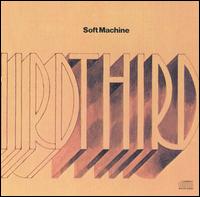 Soft
Machine: Third (1970), ****1/2
Soft
Machine: Third (1970), ****1/2
Now things get
serious: two LPs and
four tracks. After this point Soft Machine melded contemporary
jazz with the more experimental aspects of rock, but mostly strayed
into the former, never to return. Nor is it the same old
players, having bolstered themselves with the horns from Keith
Tippett's band, although mainly highlighting saxophonist Elton Dean.
The album opens with Hopper's "Facelift" - which opens with organ
oddness and aimless,
wailing horns in the first 5-1/2 minutes, before breaking into a
regular song. But it's not a pop song - it's basically a jazz
instrumental and Hopper splices two different live performances for
this version. Raetledge is even more catholic - "Slightly All The Time" is straight tasteful jazz focused
on Dean's saxophone. "Out-Bloody-Rageous" veers
between jazz and Terry Riley-like electronic minimalism.
Wyatt
alone retains the pop sound from their earlier albums on "Moon
In June". Showing a split with the others, most of the
track is a multitracked Wyatt solo, performing a medley of early Soft
Machine songs which trail off linked with skat or instrumental sections
before the band comes in towards the end and everything loses its
shit. Fascinating. Almost a perfect
album, except for some dry spots here and there, and the potential
off-puttingness of "Facelift". Self-produced.
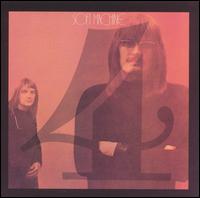 Soft
Machine: Fourth (1971), ****
Soft
Machine: Fourth (1971), ****
Soft Machine: Fifth (1972)
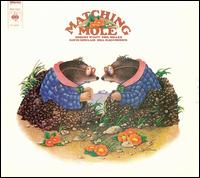 Matching
Mole (1972), ****
Matching
Mole (1972), ****
A
continuation of Wyatt's more pop sensibilities and experimentalism,
after Soft Machine junked them. Fans of the Canterbury scene or
Wyatt's work with Soft Machine will love Matching Mole, but
others may find it too abstract. The
rest of the band are not the sort of jazz-focused players that the
Soft Machine bunch had become, and the album is far more about
texture and atmosphere than soloing. Sure, Wyatt added
a great deal of mellotron to the album, but he used it more as a lead
instrument. Guitarist Phil Miller added little fuzzed bluesy
parts, Dave Sinclair also distorted his organ beyond recognition,
both styles grounding the album in more traditional rock. The
songs are generally focused around one musical phrase, and then
loosely improvise with it, sometimes fall apart into noise, only to
recover. The album is put together well also also as each side
flows.
Matching
Mole opens up normally enough with "O Caroline," a
heartbreakingly sincere piano ballad with Wyatt's tender vocals.
If Matching Mole were to be remembered for one thing, it would be
this beautiful track. Wyatt's vocals turn more idiosyncratic as
it evolves into the next track "Instant Pussy," with Wyatt
doing scat while the band does their thing. This then turns
into "Signed Curtain", another piano song, but in true
Canterbury style, it only has placeholder lyrics. Thus, the
first verse mainly consists of Wyatt singing "This is the first
verse." Clever, and a good tune besides. In the end,
it is like "O Caroline" - a self-conscious effort by Wyatt
to reach out.
The balance of
the album is instrumental, and moves from structured phrases to noisy
disarray with humorous titles ("Instant Kitten", "Beer
as in Braindeer"). This can be challenging stuff, and not
for not everyone. The side opens up with overlapping mellotron
sounds, evoking Soft Machine's "Out-Bloody-Rageous" and, by
extension, Terry Riley. In other places, it sounds like nothing
is going on, and that the group has let themselves go too much. But
then they turn around and deliver another quirky irresistible riff
amidst madness ("Dedicated to Hugh"). The entire
album ends in one fantastic creepy mellotron track, "Immediate
Curtain," which is the epitome of the group's focus on creating
a feeling, not a fixed tune. It has the same eerie qualities as
incidental music from 2001: A Space Odyssey. Those who
like their music with both humor and a bit of instrumental madness,
will enjoy it. Produced by the group, with Wyatt writing
everything except Miller's "Part of the Dance". The
band was mainly Canterbury folk - Sinclair was from Caravan, and
bassist Bill MacCormick was in Quiet Sun with Phil Manzanera.
Sinclair actually left during recording to go back to Caravan, and
was replaced by electric pianist Dave McRae, also a distorter.
Hard to tell who plays on which track, what with all the altered
noises around.
Soft Machine: Six
(1973)
Matching Mole's Little Red
Record (1973)
Produced
by Robert Fripp, and Eno pops up here. Their last album.
Soon afterwards Wyatt fell and became partially paralyzed. Miller
later formed Hatfield and the North with Sinclair.
Soft Machine: Seven
(1973)
Soft Machine: Bundles
(1975)
Soft Machine: Softs
(1976)
They released many
more albums, plus tons of solo albums.
Time to save
yourself? ...Return to the Music Page.