The Kinks
Where
have
all the good times gone?
Albums reviewed on this page: Kinda Kinks, The
Kink Kontroversy, Kinkdom,
Face
to Face,
Something Else,
The Kinks are
the Village Green Preservation Society, Arthur
or the Decline and Fall of the British Empire,
Lola
versus Powerman & the Money-Go-Round, Part One, Muswell
Hillbillies,
Everybody's in Show-Biz,
Everybody's a Star, Preservation
Act
I, Preservation Act II,
A Soap Opera, Schoolboys in Disgrace,
Sleepwalker, Misfits, Low
Budget.
The
Kinks started out as a heavy R&B band, churning
out riff
laden rock that was the mid-60s hard rock --songs like "You
Really Got Me" and "All Day and All of the Night".
The Kinks lightened up soon enough, as Ray Davies
became a talented songwriter in a different way from his
contemporaries, focusing on social satires or character portraits
much like "Eleanor Rigby" and drawing from music hall
material. In the later 60s, the
Kinks didn't embrace psychedelia; instead their music evoked pastoral
scenes and British whimsy in a lighter vein. The
Kinks are
the Village Green Preservation Society was the culmination of
this approach, and sounds about as removed from works like Led
Zeppelin as
can be. The Kinks represented an
alternative path --one without synthesizers, lightening-quick
guitar or massive amounts of LSD-- a path that was as worthwhile and
interesting as the more popular ones around it. The result
was
that their records didn't always chart, but their peak period
was similar to that of the many other first generation English bands,
from around 1966 to 1971 or so. Post Muswell Hillbillies, the
band drifted into Ray Davies centered musicals and concept albums laden
with everything imaginable.
The
UK albums are now canonical, and if you're going to buy
Kinks albums on CD, buy the re-releases.
The bonus tracks are necessary --the Kinks focused mainly on the
singles market, and as a result many of their greatest songs were
left off of albums. Their singles continued to chart long
after
their albums ceased to make an impact. If you already own
their
albums and don't really want to buy them over again, try the double
CD The Kink Kronikles which contains most of these
tracks,
with some duplication of album tracks. It is what a
compilation
should be - their best tracks, regardless of how they did in the
charts.
Personnel:
Mick Avory (drums), Raymond
Douglas Davies
(rhythm guitar, some keyboards, vocals), Dave Davies
(lead
guitar, some vocals), and Peter Quaife (bass,
background
vocals). Quaife replaced
by John
Dalton
in 1969. John
Gosling
(keyboards) added starting with Lola.
They later added a pile of horn players for a while in the mid-70s.
Dalton leaves, Andy Pyle replaces him in 1977, before leaving
himself in 1978. Then Gosling leaves, replaced by Gordon John Edwards for Misfits. Both
Edwards and Pyle had enough of Ray's crap and left after that album,
with Jim Rodford of Argent
becoming the bassist. After Low Budget, Ian
Gibbons became the
keyboardist (does anybody really care about this?). Finally,
Avory left in 1984, and Bob Henrit of Argent replaced him, because he
had nothing better to do, or he loved Rodford, or Rodford owed him
money and this was the only way he could it back. Or
something.
The
Kinks (1964)
"You
Really Got Me" was their debut's star; uncoincidentially, the American
LP was named You Really
Got Me.
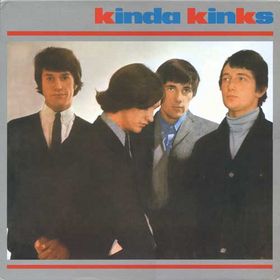 Kinda
Kinks (1965), **
Kinda
Kinks (1965), **
There's
a divide between the Kinks' singles and their albums early on, with the
albums cut with filler while the singles had the real action.
The
band was playing R&B
dance music of the era with some slower acoustic
ballads rounding things out, although nothing has the bite of "You
Really Got Me." There's only two real
surprises on the album. First, its a bit surprising
to hear Dave have a large vocal presence, singing four songs:
the best is the boisterous "Got My Feet on the Ground" followed by the
chugging "Wonder Where My Baby Is Tonight". Second, is that
the
Davies wrote almost all the songs, rather than recording just covers.
However, home-grown does not
mean good, as the only bona fide classic on Kinda Kinks is
"Tired of Waiting For You" - a gentler riff-based song than their big
hit.
Ray's slower, acoustic song are mostly weak ("So Long", the
Spanish-tinged "Don't Ever Change"), excepting "Nothin in the World Can
Stop Me Worrin' 'Bout that Girl" which builds itself out
slowly.
Otherwise, there's a lot of rote R&B ("Look For Me Baby", the
Dave-sung "Naggin'
Woman", "Come On Now"), even Motown ("Dancing in the Street") .
The playing is fine, although there's little room for the
band to
do much beyond playing like a giant rhythm machine, with barely a
guitar break. This is now a canon
album and was also
released in the USA, with another LP,
Kinks-Size,
around the same time.
On their singles the
Kinks were
good to great, frequently with the guitars turned up on the
R&B and Ray quickly turned towards embryonic power-pop.
The
good: the dance pairing of "You Shouldn't Be Sad" and the slower
"Something Better Beginning". The great include the classic
stomper "Everybody's Gonna Be Happy", "Set Me Free" which trades on
more riffs, and "See My Friends" which foreshadows the
popularity of Eastern/Indian influences. "Well Respected Man"
is one the earlier
examples of Ray's sartorial character portraits and an excellent one at
that. If these tracks were on the album
instead of what was actually released, it would get a much higher
rating. Also of interest is Ray's demo for "I Go to Sleep"
with
him singing and playing the piano, sounding like some bedroom pop
artist. A good portion of
what appeared on the US album Kinkdom
appear as bonus tracks on CD releases.
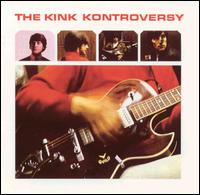 The Kink Kontroversy
(1965), **1/2
The Kink Kontroversy
(1965), **1/2
In
the early days, the Kinks churned out albums and EPs at a quick rate,
about one every six months, so consistent quality was a problem.
Kontroversy
is built around both sides of their single, "Till the End of the Day"
and "Where Have All the Good Times Gone". The former adopts
the
harsh guitar and energy of their other early R&B songs, but
uses it
for a poppier hedonistic song. The latter draws from the
music
hall for Ray's pleasant drink and sing-along song. Both
indicate
the band's future direction - reminiscence, booze and satire - as does
the decent "Ring the Bells" a lighter, acoustic tune. The remainder
shows the band quickly pressed into service, some of which are the
barest of ideas; a
few pleasant uptempo pop songs ("The World Keeps Going Round", "When I
See That Girl of Mine"), easily forgotten R&B, usually
with
Nicky Hopkins' piano twinkling in the background ("Milk Cow Blues",
"You Can't Win"), and a Dave Davies' vocal number ("I Feel
Free?"). Produced by Shel Talmy.
Just to be
confusing, this was released in the US, after the below album, Kinkdom.
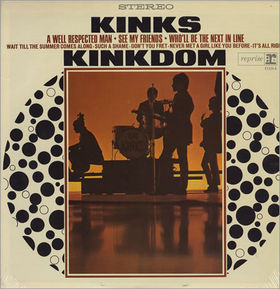 Kinkdom
(1965), **1/2
Kinkdom
(1965), **1/2
On
the American side of things, this was the Kinks' fourth album,
following The Kinks, Kinks-Size
and Kinda Kinks.
There's no reason to own it now, and it was a false transitional album
at time, as its tracks were drawn from the
band's entire existence. Ray had a few excellent new ideas -
his
first biting satire on "A Well Respected Man", the
droning Indian-like "See My Friends" which foreshadows the
popular use of sitars without using them, and a classic dance song
"Who'll Be the Next in Line" with a nice descending verses.
Aside
from
these, Ray is not particularly inspired, writing lukewarm tracks like
"Such a Shame", "Don't You Fret" and the
Beatles-style knock-off "Never Met a Girl Like You Before".
He even cannibalize previous work, with the opening of "Never
Met a Girl Like You Before" copying "Tired of Waiting for
You", and "I Need You" is another re-write of "You
Really Got Me". Dave contributes one song, the decent
acoustic
country
tune "Wait Till the Summer Comes Along". The album's cover
versions are sinkholes - the annoying "Naggin' Woman" and a
pointless version of "Louie, Louie". With "You Really
Got Me" masquerading as "I Need You", and "Louie
Louie" present, this album should have just been called Ray
Davies'
Few New Ideas and the Hits of 1963-64. Warning: the "stereo"
version of this album is just a poorly spread mono version, and can
cause headphone headaches.
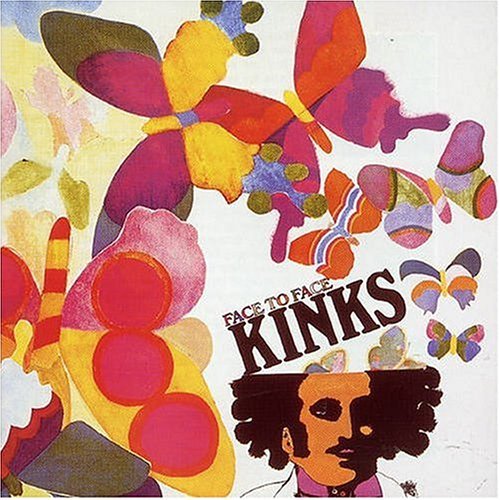 Face
to Face (1966), ****
Face
to Face (1966), ****
Ray
Davies had matured by this time, writing with a lighter,
but not less substantial style than many of his
contemporaries.
Face to Face was pretty sparsely recorded, without
orchestral
backing or any session players outside of Nicky Hopkins.
Ray's songs take the form of character sketches ("Dandy",
"Little Miss Queen of Darkness"), social satire ("A
House in the Country", the hit single "Sunny Afternoon")
and are splendid. The opening track "Party Line"
echoes the Beatles' own Rubber Soul, and there are
few
respectable rockers ("You're Lookin' Fine", "I'll
Remember") that don't quite measure up. Ray even comes up with a
wonderful Eastern song ("Fancy" with sitar-like, droning
guitar). Despite some shortcomings in performances, the album
is a real delight.
Bonus tracks on the Castle
re-release
include the excellent singles "Dead End Street/Big Black Smoke"
and "Mister Pleasant/This is Where I Belong" along with
Dave's "I'm Not Like Everybody Else". Produced by
Shel Talmy.
Live at
Kelvin Hall (1967)
From
what I've read, it's plastered with screaming girls and sloppy
performances.
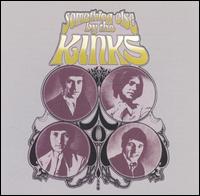 Something
Else (1967), ****1/2
Something
Else (1967), ****1/2
While
the Beatles and
Stones and everybody else experimented wildly, the Kinks
churned out an even better collection of "normal" pop
songs. Their strengths lie deeply in Ray's songwriting
talent; his words and melodies are
enough to captivate the listener,
allowing the band to dispense with soloing. The
Kinks were still a
charting singles group, and each one of these songs is written like a
single - short, melodious, some with sing-along chorus. Above
all you get the feeling that it was a hell of a lot of fun to make
this album as well. Ray has his usual portraits ("David
Watts" ,"Tale of Two Sisters") and satire ("Tin
Soldier" for one), and Dave even places three songs (the circus
oddity story "Death of a Clown", "Love Me Till the Sun
Shines" and the slightly disturbing "Funny Face"), and
they are about par with Ray's songs. The only
psychedelic influences are on "Lazy Old Sun" where Ray
sounds stoned (or possibly just blasted), and the bonus single
"Autumn Almanac" with its backwards effects towards the
end. The real gem is Something Else's
final track, Ray's
first production job, "Waterloo Sunset" with its background
vocals and simple Dave line. This song is gorgeous, and
widely
considered one of the group's best tracks, and one the era's best.
The good bonus tracks are the singles "Autumn Almanac/Susannah's
Still Alive" and "Wonderboy/Polly", the rest are kinda
bleh. Produced by Shel Talmy, with the exception previously
mentioned.
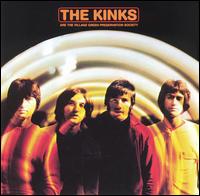 The
Kinks are the Village Green Preservation Society (1968),
*****
The
Kinks are the Village Green Preservation Society (1968),
*****
What
the heck year is this? 1968? You'd never know it from this
album; granted, some unobtrusive mellotron crops up here and there,
but one of these tracks was recorded two years prior and blends right
in. Anyway, this is Ray Davies' first attempt at a concept
album and it is focused on pastoral life, fairy tales and a faint
sense of the glorious past. Ray throws in
some satire ("Big Sky" and "Do You
Remember Walter"), but it is much more subtle than before.
This is about as uncool as one could be in the age of psychedelia;
Ray's production was straightforward, and he played most of the
keyboard parts. Sure, Dave's distorted
guitar and creepy vocals on "Wicked
Annabella"
gets
close to
psychedelia,
but that is about it. Instead, we
are treated to more of the usual --short songs (with one exception)
that are imbued with happiness and fun, not to mention the sing-along
choruses. Picking stand-out tracks is hard - the title track
is
great, and "Big Sky", "Monica" and
"Starstruck" are among my favorites - and the sole complaint may be
that "Picture Book" and "People Take Pictures of Each Other" are close
in subject matter. A pop touchstone.
Released with little
publicity,
the album disappeared quickly, and there was no tie-in
single.
The CD bonus tracks are the original pulled 12-track album in stereo
(the rest is in mono) with one unreleased song "Mr. Songbird",
and the subsequent single "Days". So, not as a good
as some other albums, and the stereo tracks aren't quite CD quality,
but still nice.
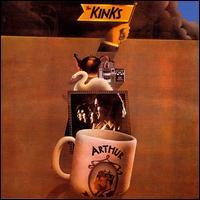 Arthur
or the Decline and Fall of the British Empire (1969), ****1/2
Arthur
or the Decline and Fall of the British Empire (1969), ****1/2
Initially
dismissed as a Tommy clone, Arthur proved
that the
Kinks could rock after all, and it and Village Green
are two
of the best albums never to hit the charts. Granted, Arthur
continued some of the themes of Village Green
("Victoria"
which should have been a hit single), but it was also a stunning
indictment of contemporary society that was at least as intense as
their older work ("Brainwashed", "Shangri-La"),
and anti-war themes ("Some Mother's Son which is the most
beautiful and poignant anti-war song ever.)
It's not an
even a double-album, for pete's sake! The band's playing is
also good - Dave starts playing leads and gets pushed up in the mix
with great results ("Brainwashed"). Plus, Avory's
drumming is not to missed ("She's Bought a Hat like Princess
Marina"). The lyrics are probably Ray's best, lifting such
lighter songs as "Drivin'" and "Young and Innocent
Days" far above previous works. There's only one
questionable patch, and that's the overlong jam that mars the end of
"Australia" which prevents
this album from getting five stars. Gosling appears on
keyboards but stays in the background like a good session
man.
Ray produced, and the re-released CD is in stereo (yeah!).
Bonus tracks include the "Plastic Man/King Kong"
"Drivin'/Mindless Child of Motherhood" singles (the latter
is far better).
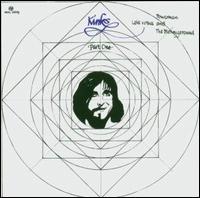 Lola
versus Powerman & the Money-Go-Round, Part One (1970),
***1/2
Lola
versus Powerman & the Money-Go-Round, Part One (1970),
***1/2
You
could hear the beginnings of the Kinks' new sound in the title track
of Arthur. Always having a good time, the band went
kinda
Stones-like on Lola,
with new guy Gosling playing like Nicky Hopkins' younger
brother, and Dave picking up the banjo. While the sound may
be
closer to the Stones than the music hall, the writing is far
different. Ray took this time to put together a album around
the music industry and fighting/escaping it. Some of the
songs
like "Denmark Street" and "The Moneygoround" may
be accurate, but are not up to Ray's usual level. He still
dishes out the goods on songs like "This Time Tomorrow",
"Get Back In Line" which is in their earlier style (sounds
like a single) and the delightful "Apeman". Let's not
forget "Lola" either - it was the groups first big single
in a few years. Dave also shapes his act up, delivering two
strong songs "Strangers" and "Rats", which prove
he can sing fairly well, and otherwise sounding a lot heavier ("Top
of the Pops"). Although not as strong as previous albums,
well worth it. R.D. produced.
Percy (1971)
Soundtrack
to a TV film. Usually slagged.
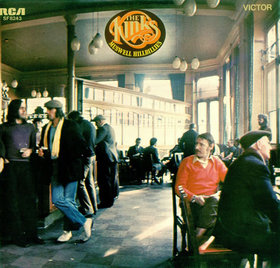 Muswell
Hillbillies (1971), ****
Muswell
Hillbillies (1971), ****
Ray
had been writing about the evils of the city and society (with a
smirk), and the treasures of the country (with a sigh) for most of
his career. Certainly there were feelings besides sarcasm and
a
desire to mock trends behind Ray's songs all along, but here
he
gives in to his own disillusionment. The trouble is that by
1971, the hippie's idealism had also worn out, with plenty retreating
to the hills musically with the fallout from Altamont. While
the Kinks were certainly not among this group they went the same
route, giving a frank voice to the doubts Ray had been voicing all
along. The problem is that they chose the same route as
everyone else - roots-rock - and a touch later than most. It
may be less innovative and authentic for the Kinks to delve into
folk/country/rock, but it really suits them. At the center of
the sound is usually Ray banging out a song on an acoustic guitar,
Dave contributes plenty of slide guitar and the rest of the band fill
out the sound as usual. One of the more disturbing aspects of
this is that the band sounds so American, rarely delving into the
overtly English demeanor used so often in the past ("Holloway
Jail" is a slight exception). There's a great deal of
American roots-rock of the Grateful Dead ilk ("Uncle Son")
and Dixieland jazz arrangements on some tunes ("Acute
Schizophrenia Paranoia Blues", "Alcohol") a la Randy
Newman. It may lead one to wonder if this is really the
Kinks,
but at the heart of it all are Ray's lyrics, and if there's anyone
who'd use rustic music with lyrics on the plight of suburban/urban
people, it's him. Ray's attitude towards his songs' subjects
has changed; before he was mocking or commenting (think "Sunny
Afternoon") and here he either does a good job portraying ("Here
Come the People in Grey", "Holiday") or is personally
invested in the lyrics ("Alcohol", the beautiful, expansive
ballad of a working girl's dreams "Oklahoma U.S.A.").
In fact, the weakest tracks are those "typical Kinks songs"
where Ray gets mocking or overly happy (the tongue-in-cheek "Skin
and Bones" and the happy "Have a Cuppa Tea"). A
bittersweet retreat by a man from the perils of the modern
city.
Produced by Ray.
(Old
review here)
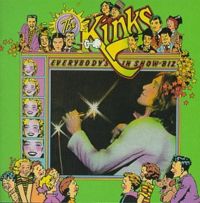 Everybody's
In Showbiz, Everybody's a Star (1972), **1/2
Everybody's
In Showbiz, Everybody's a Star (1972), **1/2
Everybody's
In Show-Biz, Everybody's a Star marks the start of the Kinks'
mid-70s decline, which was largely a result of Ray's theme and music
recycling, and a simultaneous idea shortfall. The album is half
studio, half live, and the band's problems show most obviously on the
studio side (Everybody's in Show-Biz). Their new
material is
a hybrid of Muswell Hillbillies and Lola:
rootsy
loosely based around a rock star's experiences, and with a strong
satirical bent. The music sounds like Muswell Hillbillies warmed
over - more Dixieland horns ("Maximum Consumption", the
drunken "Unreal Reality") and roots-rock ("Here Comes
Yet Another Day", the middling "Hot Potatoes" or the
gentle, escapist "Supersonic Rocket Ship" which perplexedly
was a UK hit). Little of the band's rock really clicks; "Here
Comes Yet Another Day" kicks off the album and is the only true
good rock song. While the others are not bad ("Motorway,"
"You Don't Know My Name") they are not going to make anyone
forget about the Faces. Instead, Ray's taste further reverted to
prancing Salvation Army music-hall ("Look a Little on the Sunny
Side") and his biting lyrics have taken a oddly gastronomical
turn (the sing-along "Hot Potatoes" or "Motorway"). Well, Dave Davies
does have a spotlight song ("You Don't Know
My Name"), but it's more an opportunity to debate whether his
strained voice sounds more like Ray's merged with Dylan or Ronnie
Lane.
You
can almost predict that after all the clever songs about indulgence,
the "comedown" song will crop up; a slower, more
introspective or observant work, similar to Muswell
Hillbillies'
"Oklahoma U.S.A." This album has a pair, and the fine
"Sitting in My Hotel" is the more bitter and honest of the
two. The songs' lyrics of confusion and dissolution probably refer to
Ray himself; who else was "writing songs for old time vaudeville
reviews?" The other settled track is "Celluloid Heroes"
- Ray's guided tour of the Hollywood Walk of Fame, and antithesis to
the stars ("everybody's in movies, everyone's a star"). The
latter is an excellent track, and one that I still hear on the radio.
Ray being Ray, he would later revisit this topic with A Soap
Opera. Altogether, Show-Biz is
a
disappointment, and fails to continue Muswell Hillbillies'
vector.
The
live side (Everybody's a Star) holds few surprises.
The band
eschews their earlier hits, only going as far back as Arthur once
("Brainwashed" with the horns put to good use); the rest
are Muswell Hillbilly tracks. Ray sounds like a
drunk showman
throughout, tossing in snippets of extraneous songs ("Mr.
Wonderful", "The Banana Boat Song", "Baby Face")
and generally acting up (is his pandering, faux version of "Alcohol"
ironic, or was the original written with this jokey exaggerated
attitude neatly concealed?). Dave never gets to do much, and the half
ends in the most ignoble way possible, with a pointless audience-led
rendition of "Lola". The juxtaposition of a satire on rock
stars and a sloppy performance is rather odd; was Ray commenting on
himself throughout? Perhaps his subsequent retreat into Preservation
themes simply a better way of dealing with whatever problems he had,
after the moments of self-reflection. Or it could have a reflection
of his greater ambition, that of Show-Biz, of writing movies or
scripts, so frustratingly reduced to the concept albums that
followed. Or he could have just be sloshed throughout. Either way,
this was the start of an artistic lull.
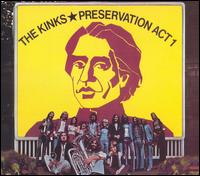 Preservation
Act I (1973), **
Preservation
Act I (1973), **
Preservation
Act I has plenty of problems. First, it is a vague and
disorganized concept
album; plenty of
songs are story-related, but lack plot
("There's a Change in the Weather, "Here Comes Flash").
Second, it is no mistake that the name is reminiscent of VGPS - Ray ransacked his own back catalogue. It is
pretty blatant, too - "Where Are They Now?" reworks
"Dedicated Follower of Fashion", and "Sitting in the
Midday Sun" turns the relaxed sound of "Sitting by the
Riverside" into a video-game soundtrack.
Finally,
the
brothers Davies were not getting along too well at this point, and
Dave is pretty much absent from this album. Without him, the
band really lacks edge, and the addition of the Mike Cotton horn
section and female backing singers make the sound like a B-grade
musical with Ray Davies singing almost all of the parts. Even
so, it
would not be as bad if Ray had not also
lost his lyrical
sharpness.
Lerner and Loewedown present Ray Davies, Stuporstar.
Still, Preservation Act I
has a few decent moments, such
as the album opener "Morning Song" whose wordless opening
is nice but best suited as entertainment in a retirement home, the
inflated "Demolition", or parts of "I Am Your Man".
The album's main redeeming grace is the flop single "Sweet Lady
Genevieve", a vaguely rootsy mid-tempo rock ballad which was (probably)
shoehorned onto the album, but stands far above
everything else here. Produced by Ray.
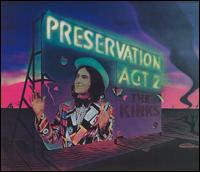 Preservation
Act II (1974), **
Preservation
Act II (1974), **
Better in almost every imaginable way than Act I.
As Paul Harvey says, "and now, the rest of the
story,"
or in this case, the actual story. Ray delivers plenty of
action via periodic radio announcements, and
thus the need for story-only songs largely
disappears.
Dave rejoined the fold, enabling the band to rely on
their basic, solid sound and giving them a harder edge. All
of
this would be meaningless had Ray not written good
songs. Most are cast in a fairly dark and/or bluesy
mold and rely on strong playing from the three non-Davies ("He's
Evil", "Nobody Gives", "Introduction to
Solution", "When a Solution Comes"), and "Money
Talks" is frighteningly close to the Stones. Seriously -
stinging slide guitar from Dave, female backing singers, basic yet
competent rhythm section, and horns to boot - all they needed was
another guitar and Jagger's vocals. Like Act I, the
group's latest romantic single ("Mirror of Love") is
irregularly placed, but it is nothing special aside from Ray's oddly
Marc Bolan-like vocals. Act
II's
largest problem is one that plagues many a double album: there simply
is not enough good material to fill out two LPs. There is
some
light experimentalism like the mock Cromwellian "Shepherds of
the Nation" or "Flash's Dream (The Final Elbow)", a
conversation between a sound-altered Ray Davies and a nasty Ray
Davies followed by a boring sound collage. All of this is
compounded by Ray's inexplicable decision to turn most of the lead
vocals over to one of the inferior female backing singers on the
final side of the album (ruining the dreamy, jazzy "Nothing
Lasts Forever"). If this were condensed into one album it
would help, but as is it absolutely pales next to contemporary
efforts like Quadrophenia, or Dark Side
of the Moon.
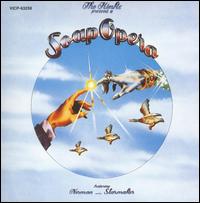 The
Kinks Present A Soap
Opera (1975), *1/2
The
Kinks Present A Soap
Opera (1975), *1/2
This
project encompasses all aspects of mid 70s rock malaise -
self-indulgence, non-biting
satire, middling rock tunes, grand ambitions and recycled
themes. The album's basis was a Ray television musical in
which he starred; but the whole thing is just Everybody's In Showbiz,
Everybody's a Star: the Musical,
and the music is a
bunch of hammy tracks augmented with dialogue and narration from
the television show. It opens with a watered-down version of
a familiar Kinks chord progression and rarely becomes more
interesting. Since most of the music was used to back Ray's
performance, the band (including the now-usual array of backing
singers, horns, etc.) is turned into a
straitjacketed high-school pit
orchestra. Appropriately, most songs have
a lame stage
musical ("Nine to Five") or 50s rock feel ("Rush Hour Blues", "Ducks on
the Wall"), but Soap
Opera lacks even one great song. Even had the music
been stronger, disappointment
would probably arise. Most
of the
album is about the dullness of ordinary life and the music matches
this. Sure, Ray has his required heartfelt ballad is "You
Make It All Worthwhile", but it isn't terribly good, and the plot
punctuates it. Some of the songs are acceptable (the
self-reflecting "Underneath a Neon Sign", "Nine to Five" or the 30s
throwback "Holiday Romance") but nothing the Kinks had not done better
previously. At best, the entire
project is supposed to
crest with the polite anthem "You Can't Stop the Music" - a tribute to
departed rock stars, but its good-time, glass hoisting plodding isn't
worth any enthusiasm.
That
is, crest if you can follow the story - a muddled combination of Pygmalion and the Prince and the Pauper.
(The plot is a lot clearer in the TV program which is on
Youtube, but it should only be watched
under duress, or if you have a thing for dancing chorus members,
platform shoes, boom mics and low budgets). Ray (the
Starmaker) announces he can make anyone a star. Then, within
the same song/track announces that he's going to use a dullard named
Norman as fodder for his art. He then changes
places with Norman, but that doesn't mean anything as Norman never
appears, and Starmaker decides to remain in Norman's life at the end.
Ray plays (and I mean plays) Starmaker as a self-aware,
cocky, silver jumpsuit wearing person who learns blah blah blah.
But Davies is just as full of himself as this character is -
the vaguely-self referential plot is just a poor justification
to make fun of pop stars and the drudgery of ordinary life.
Nor is the satire sharp - the story has been told a million
times, and Davies only tells half, without new insights.
Starmaker was supposed to be so good that he could make hits
out of dullness, but Ray Davies can't do it. (Maybe because,
as David Foster
Wallace noted, dullness
is terrible subject matter).
To make things more confusing, the album includes singles
from outside this mess - "Holiday Romance" is a
self-contained song which makes little sense in this context (is
Starmaker cheating on Norman's wife?). Even worse is the
grossly annoying "Ducks
on the Wall", about bothersome stuffed ducks, replete with
duck call noises. An album about boringness, which is itself
generally boring.
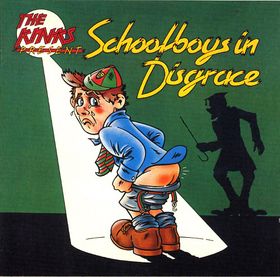 Schoolboys
in Disgrace (1976), **1/2
Schoolboys
in Disgrace (1976), **1/2
or
The Restoration of Dave
Davies. This album marked the Kinks' return to actual rock
music. Dave
is uncaged and the horns and backing singers are mostly excluded.
Sure,
it's a concept album grounded
deeply in Ray's persistent reminiscing,
but thankfully one without much of a narrative. The
music
too, has a retro tint, with nods to the sock-hop era ("Jack the Idiot
Dunce", "The First Time We Fall in Love") or the Kinks' own beginnings
("The
Hard Way"). Ray still had some grandiose ideas to work
out
of his system, but for
the
first
time in several albums his
lyrics are fairly interesting. He still had some excesses in
him, such as "Education",
a
seven
minute rock song about the general and personal history of education
that would have fit right in on Everybody's
a Star.
Other songs include parody/homages to sock-hop biography dance craze
songs "Jack the Idiot Dunce", or 50s love songs, intercut with Ray's
own
bitter commentary ("The First Time We Fall in Love"). Most of
the
rock songs are problematic in some respect, although the band
regained some catchy riffs. For example - "I'm in
Disgrace"
opens with a frilly piano intro, but rapidly turns into a good little
rock
song with riffs. Alas, it is blemished only by the line "it
wasn't lust, it wasn't
rape, it was
just a mistake," which can be interpreted in a very bad way.
Elsewhere, Ray's lyrics and the all-to-familiar chord pattern
make
"Headmaster" list a bit, and the clipped and rocking "The Hard Way"
recovers an old chord pattern from the Who. (Still, borrowing
from your own golden years is better than completely losing yourself
in the mid-70s malaise.) The strongest song
is "No More Looking Back" a gradually building song, where Ray
renounces that approach while
haunted by memories of the past. Much like Soap Opera's
"Underneath a Neon Sign" it's a song where Ray doesn't appear to affect
a persona and sounds the most sincere. A promising return.
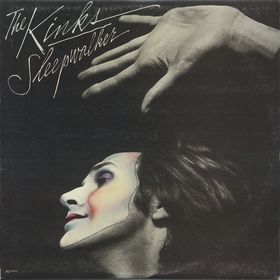 Sleepwalker
(1977), ***
Sleepwalker
(1977), ***
This
marked the band's resurgence, an improbable third act as a popular
arena-rock band as Ray woke from his theatrical slumbers. The
second step to Schoolboys'
change
in sound: no extra singers or horns, but plenty of Dave's guitar
and rock. The
Kinks' never made particularly heavy or dirty rock after their
first
few years - as Ray appealed to his listener's minds without trying to
blow out their ears. This measured approach resurfaces here,
as
their music is still rather clean and regular, even though cranked to
arena-rock levels. It was as if
Ray used Everybody's in Showbiz
as a starting point, and then borrowed to make up. Yet, their sound is weird in that the
more successful songs echo the
Kinks' contemporaries - in the past: "Life on the Road" feels like
early 70s Rolling Stones (or more like Everybody's in Showbiz)
and "Juke Box Music" sounds like mid-70s Who. Hand in hand
with this, sometimes Ray sings like he's
echoing other rock
stars - "Life Goes On" has a touch of Ian Hunter, and the bonus track
"Artifical Light" is a detached Gary Brooker. Lyrically, Ray
returned to Showbiz-era
themes such as the music industry ("Life on the Road", "Mr. Big
Man"). Sleepwalker also
avoides Ray's sharp wit, which appears only on "Mr. Big Man" and a
touch
in "Life Goes On", which jokes about suicide. Yet, Ray still pulls
out a few topic surprises, such as two stronger monster
(werewolf?) autobiographies (the title track and "Full Moon"), and a
slight character portrait in "Juke Box
Music". (I'd rather hear Ray sing about someone than attempt
to portray them.) Both of the
werewolf (or what-have-you) songs are good rock numbers, as is "Life Goes On".
Alas, not every hat fits the man, and the less said
about the leftover
60s spirit + arena anthem of "Brothers" (unintentional irony there) or
the soft rock of "Stormy Sky", the better. Still, at least
there
was no attempts at disco or anything. There's still plenty of
bloat to go around,
from long track running times to slighly proggy
introductions, but on the whole,
this documented the Perfectly Acceptable Kinks, if not
particularly exciting ones.
This
was Dalton's last album with the band, and Andy Pyle's more excited
rock bass appears on "Mr. Big Man". The bonus tracks
show Ray had not lost his wit, mocking the "Prince of the Punks" or
"The Poseur". "On the Outside" is a decent character
portrait, with a chorus you can sing-along with, just like an older
Kinks song. I wish they had put that song on the album rather
than any number of tracks.
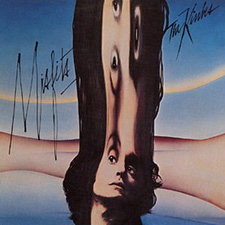 Misfits (1978), **
Sonically, Misfits is
more mainstream than Sleepwalker,
but Ray returned his
old satire/social commentary mode, and the resulting album tries far
too hard.
Misfits'
more successful tracks are still arena-rock bangers: "In a
Foreign Land" about tax exiles, and some cultural implosion
documentation on "Live Life". Even though he was
concentrating on current affairs, Ray
also appeared to think he could write a song about anything, be it cross-dressing ("Out
of the Wardrobe") or allergies ("Hay
Fever"). Some of the commentary is ridiculous as well, such
as their reggae
jab at racism: "Black Messiah". Yes, the Kinks did a reggae
song
with Ray adopting an accent at times, moving themselves a few steps
closer to Weird Al Yankovic.
(In a particularly tone deaf move, it was released as a
single in
the UK.) It gets worse, however, as the album ends with an
unbearable,
Call-to-Action! disco/arena-rock
hybrid ("Get Up"). Ray's old topics get
an airing as well. His eternal interest in the ordinary
people shows on the opening title track, a gentle song coaxing a misfit
back into the general population. Yet, the music sounds like
a
sterile, non-technical version of a Dire Straits song, and the lyrics
are a quantity of clichés. Rock music about rock music (or
meta-rock) also continues with "Rock N Roll Fantasy", a bit of 'folks
love rock music' ala "Juke Box Music" combined with some
self-mythologizing. It is also pandering, over-long, and was
a
hit in America. Dave even sneaks on a middling rock ballad
("Trust Your Heart") which I guess is a good sign for the band's
internal dynamics. Granted, this album was a success and a
fair number of people like it, but it is quite empty. Ray's
middle-class observer persona (that closest to his actual
self) lacks the oomph of a punk's complaining, and is entirely diluted
when placed alongside trite crap like "Hay Fever". I realize
the silent majority of undiscriminating, ordinary rock fans were
unperturbed by the band's lack of an edge, and heard someone
singing to them and their worries. However, Ray could
have hit his demographic with music that was more than the
equivalent of an
off-brand breath mint, and without resorting to clichés or reading the
news. Disappointing.
The
CD version I heard includes some bonus tracks, the only important one
being their Christmas single, "Father Christmas", which combines some
Clash-style guitars with Ray's lyrics about poor kids mugging Santa
Claus. It's actually a pretty awesome song.
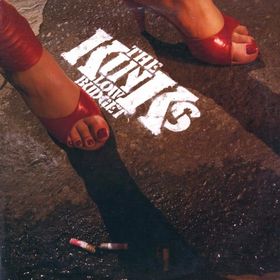 Low
Budget (1979), ***1/2
Low
Budget (1979), ***1/2
The
best rejuvination-era album yet, mostly just a tweaking of the Misfits approach. Low Budget
is trying to be an uplifting rock record, for those who want to follow
contemporary trends without all the political or social baggage of
being a punk fan. Musically,
Ray borrowed punk,
contemporary-era Who, new wave and arena-rock into a (usually) loud but
catchy combination that was something like an import-substitution
product for those who put off by younger bands. Maybe
he realized that his talents shown best with those genres/productions
rather than bland atmospheric songs or soft throwaways.
Although
the songs are better, the real change is in Ray's lyrics. Low Budget drops
the Living
Newspaper
approach on politics, save the throwaway half-blues of "A Gallon of
Gas". Instead, it continues on his eternal
fascination with
fake people, but instead of dandys, his scorn is directed towards
punks, etc ("Attitude", "Little Bit of Emotion", "Misery").
Yet,
Ray's commentator is always tries to coax or goad the objects
of
his cycnicism into his own more authentic middle class values.
Misfits'
title track was essentially one big welcome-home hug, for example, and
he duplicates that approach with the stripped-down acoustic "Little Bit
of Emotion" here. Of course, the record isn't really aimed at
those people (hard to imagine Sex Pistols fans casually putting on an
late 70s Kinks album), but those on the fence. Nor is Ray
himself
particularly authentic (the theatrical productions, his age).
Maybe he realized his audience was mainly Americans who didn't want to
hear about race relations, and instead wanted to hear about superheros.
(He also avoids relationships and love, which is a bit odd.)
Musically,
Ray's buffet of trends is pretty good and he could still come up with
catchy refrains. Although Low Budget
borrowed less from the Kinks' contemporaries, the phony punk upbraiding
"Attitude" draws from Who
Are You,
but is a fine song. It's not all punk-centric,
either; Ray was cranking out superhero themed
rock as well: "(Wish I Could Fly Like) Superman" was the album's big
hit, a disco beat with some arena-rock overlaid on it. I
prefer
the other superhero song:"Catch Me Now I'm Falling" which builds around
a great riff. Ray subverts nicely
punk's formula of sped up old R&R chord changes, and adapting
it to
a fairly lighthearted sing-along song about social tension ("Pressure")
or anti-serious person son ("Misery"). Between
keyboardists, Ray provided simpler parts himself and uses more
sythesizer, which suits the band's new wave material. The good is
pretty good: both
"National Health"
and "Moving Pictures have catchy
refrains and judicious synthesizer, although the former has a goofy
topic (nervous tension and exercise). Ray can still overthink
himself, though, and "In a Space" is the downside of the band's
borrowing: overly
clever lyrically and relies on farty synth noises. Overall,
the
music is pretty good, even though it walks the fine line of trends.
All
in all, this is a successful record; musically it's a sampler, but Ray
still knew how to make good sounding music and talk about the trends.
One for the Road
(1980)
I
have this - it's good. Mainly focusing on Low
Budget
material with the expected classics included. Hiatus at this
point, because I don't have Give
the People What They Want.
Give the
People What They Want
(1982)
State of
Confusion (1983)
Word of
Mouth (1984)
Think
Visual (1986)
The Road (1988)
UK Jive (1989)
To the
Bone (1994)
Do
you remember
Walter? If not, return to the music page...