The James
Gang, Joe Walsh and Domenic Troiano
Albums reviewed on this page: Yer'
Album, Rides Again, Thirds,
Live in Concert, Barnstorm, Straight
Shooter,
Passin' Thru,
Domenic Troiano, The Smoker You Drink The Player You Get,
Miami, So
What, Newborn, You
Can't Argue With A
Sick Mind
I got interested in both
Walsh and the James Gang after reading a Pete Townshend piece in which he claimed that Walsh was the
greatest guitar player alive. Strong words, so when I found
an
album I picked it up. And lo and behold, this stuff is
good!
So, believe it or not, the James Gang were hot stuff in the late 60s
and early 70s. Hailing from Cleveland, they had
it made in the local scene by 1968, when a number of personnel
changing resulted in the dropping of the original guitarist and
keyboardist and the addition of Joe Walsh. The result was a
power trio, with Walsh fronting, Jim Fox (the James of the Gang) on
drums and Tom Kriss on bass. Granted, Walsh can sing like
crap
and frequently does - but that is why we have studios and multiple
takes. Jim Fox had the potential to rock the house which he
did on their first album Yer' Album and their live
recording,
but was overshadowed by Walsh almost entirely. Their music
turned from more Invasion-styled work to the West Coast country,
laid-back stuff fairly quickly. (And no, I can't add any more
adjectives to the previous sentence.) Despite releasing three
singles from their first album (none of which made it), the group had
some success with their albums and "Funk #49" the single
from The James Gang Rides Again. Anyway,
Walsh went solo
and I've reviewed a couple of his albums below. He joined
the Eagles in 1976, and later quit them in a big fashion. So
yeah, Walsh is a really good guitar
player, but watch out for that wavering blast of nasal whining which
occasionally erupts.
The post-Walsh James Gang
was a tabula rasa, on which visiting guitarists would impose their
styles and tastes.
Domenic Troiano and Roy Kenner were a decent
replacement for Walsh for a couple of albums, but Troiano then left for
a declining Guess Who
(who
then split after a couple of years). His
replacement was
Tommy Bolin, whose previous band Zephyr
was good, and who played on one
of jazz drummer Billy
Cobham's albums. Bolin had talent, but exausted his material
in only two albums. He quit for Deep
Purple,
went solo and then died at a young age. The band broke up,
reformed a year later and recorded two more albums before disappearing
for good. I have only the first of these, and hold no hope
for the second and final one.
Personnel: Joe Walsh (guitar, keyboards,
vocals), Jim Fox
(drums) and Tom Kriss (bass).
Kriss left after Yer' Album
and was replaced by Dale
Peters. Walsh
quit 1971, replaced by Dominic Troiano
(guitar) and Roy Kenner (vocals). Tommy
Bolin in, Troiano out,
in 1973. Band broke up in 1974 when Bolin
joined Deep Purple. Reformed with Fox, Peters,
Bubba Keith (guitar, vocals) and Richard
Shack (guitar)
in 1975. Everything ended one year later.
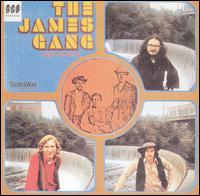 The
James Gang: Yer' Album (1969), ****
The
James Gang: Yer' Album (1969), ****
At
one point, the James Gang was one of Pete Townshend's
favorite bands, and after hearing
this album its easy to see why. Not only does Joe Walsh
contribute excellent guitar work in his debut, but the others excel as
well; Jim Fox is a fantastic
drummer, and Tom Kriss a good bassist. The trio were probably
Cleveland's biggest rock band, mixing British
Invasion with American funk and the relaxed West Coast with fabulous
results. Although some tracks may sound a touch dated (the
backwards phasing guitar line on "Bluebird"), Walsh keeps
things moving with short snappy lines and avoiding long-winded
solos. He also contributed the majority of the songs,
including
the sparkling acoustic "Collage". The covers are
mainly used for soloing by the band (Buffalo Springfield's
"Bluebird", the Yardbirds' "Lost
Woman"). The only down moment is Jerry Ragavoy's "Stop",
and, as the notes say, "the story of how we couldn't", with a
deadening twelve minute running
time. A strong power trio.
Produced by Bill Szymczyk.
 The
James Gang Rides Again (1970), ***
The
James Gang Rides Again (1970), ***
Overall,
their sound is streamlined: Walsh played fewer
big leads, Fox
drummed less, and new bassist Dale Peters is a placeholder.
Rides
Again has more songs (at the expense
of workouts), and its focus is pretty evenly split.
The first side continues the
blues-rock, opening with "Funk
#49", a culmination of the debut's sound,
complete with jungle beats and snappy licks. The remainder
have flaws ("Woman" is repetitive, for example), but are still solid
rock tracks. The back side is more laid back and folky, ("Tend
My Garden" and "Garden Gate" with Rusty Young on pedal steel) ending
with a big string-laden, melancholic number in "Ashes, the Rain
&
I".
(Yet, Walsh's
annoying voice is brought up in the mix.) Produced by
Bill Szymczyk.
 The
James Gang: Thirds (1971), **1/2
The
James Gang: Thirds (1971), **1/2
A more
democratic album, with Fox and Peters contributing
two songs each. Maybe good for band politics, but wrong
decision for the listener. Fox and Peters may not have the
Walsh nose-voice, but the guitarist was leagues ahead in
songwriting. Fox's songs are OK, with the album closer "Live
My
Life Again" repeating the title over and over again the last
three minutes or so, and "Things I Could Be" is the same
chord for over four minutes. Peters' songs are downright
bothersome; "Dreamin' in the Country" is helped a lot by
Walsh's steel guitar, but "White Man/Black Man" is
absolutely dreadful - a slow preachy gospel number that's over five
minutes long. "Sometimes I get the feelin' it's never
going to end," indeed. Walsh's two big numbers, the
crunchy "Walk Away" and the slower CSN&Y-influenced
"Midnight Man", make up the album's highlights. A
slow jazzy blues workout ("Yadig?") with Fox on vibes and
Peters on upright is as adventurous as it gets.
Produced by the group and Szymczyk.
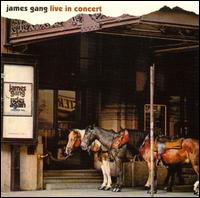 The
James Gang: Live in Concert (1971), ***1/2
The
James Gang: Live in Concert (1971), ***1/2
Carnegie
Hall, in fact. This may be the best place to start with the
band, actually, as it mostly ignores their lighter material to focus on
being a power trio, making it something like the band's Live at Leeds.
Walsh's voice is obnoxious but not unbearable, and he
experiments with wah-wah
and delay ("You're Gonna Need Me" - like an intentional version of
Townshend's echo soloing on Leeds)
and
even vocal percussion. It
mainly
highlights their blues rock, but midway through the first side, Walsh
shifts to organ for versions of "Take a Look Around" and Rides
Again's "Tend My Garden", leading into an acoustic guitar and piano
version of "Ashes, the Rain & I". The album's
problems are the mixing, with
Walsh's voice and guitar eclipsing the drums on the first side
(although it may be my record) and Dale Peters' chokes on his solo
("Lost Woman"). But this shows Jim Fox
as one of the better drummers of the day, and Walsh's
performance is excellent. (He either left the band soon
afterwards, or the label released this to recoup their loss; I'm not
sure which). If
you can stand Walsh's voice, buy it.
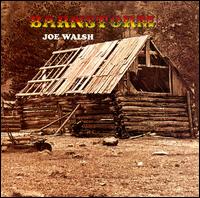 Joe Walsh: Barnstorm (1972)
, **1/2
Joe Walsh: Barnstorm (1972)
, **1/2
It
was clear the Walsh was the main talent in the James Gang, so it could
not have been a surprise when he left. His
first solo album continued his relaxing streak, but
ground it in keyboards and melodic figures, giving Barnstorm
a stronger pop influence than he had shown in the Gang.
Superficially, he kept the trio format, with Joe Vitale on
drums and
keyboards and bassist Kenny Passarelli,
both of whom worked with him for the next few years.
But the band has a different feel from the Gang's post
power-trio
days. For a
lot of the album it feels like Walsh is just exploring, such as
dropping in melodies like a prog-rock band, or playing around
with
how things sound (the grandiose parts of "Mother Says", a talkbox),
rather than scripting songs. In fact, the A-side seems to
have
the best songs, or those with confused identities: the opening "Here We
Go" is mainly an Abbey
Road hangover song, that morphs into rock via the
bleepy synth noises Pete Townshend was using at the time.
Another
song, "One and One" keeps evolving, including some fusiony parts, until
it plays itself out. The back end
lacks changes and
meandering, but is locked to the early 70s: the sunshine and clear air
vibes on "Birdcall Morning", hard rock on "Turn to Stone" or the
throwback "I'll Tell the World". Only "Turn to Stone" really
rocks out, otherwise there's acoustic guitars, lots of keyboards, some
vocal harmonies. Walsh's lyrics are not peculiar, childhood
reminiscing, hippy fables and the like, and his voice is still a whine.
Not a bad place to start with his solo career, I think.
Produced by the eternal Szymczyk.
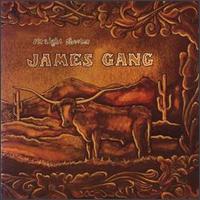 The
James Gang: Straight Shooter (1972), ***
The
James Gang: Straight Shooter (1972), ***
I
really
expected to dislike this album. After all, Joe Walsh took the
group's signature sound (and producer) with him. (Unless you
count suck as a
musical style, shown by Thirds'
non-Walsh
tunes.) But strangely enough, Straight Shooter does
not suck, with credit due to newcomers Domenic
Troiano and Roy Kenner, who wrote the songs. This incarnation
of
the James Gang sounds like a merger of its parents - the old Gang
started out playing blues and some white-boy funk, while Mandala
treated all the instruments as a rhythm foil for Kenner's voice.
Here, Troiano usually melts into the rhythm section again, while Kenner
stands out front, although the times have tempered everyone.
Most
of the
material
is not that exciting (the
opener "Madness" is the lone exception) - there's
a
goodly amount of
light funk (in keeping with the times), but the band sounds
tighter, and the music provides a
suitable use for Peters' robotic bass playing. While Walsh's
signature numbers
tended to be filled with strong guitar work (in tone), Troiano has a
knack for slower, acoustic ballad tracks (the unexpectedly James
Taylor-like "Getting Old"). These work well with
Kenner, an emotive, white soul singer who oversings often, but
lays off on the quieter numbers ("Let Me
Come Home"). Comparable to Bobby
Tench, he
sometimes needs
to be reminded that he's not Ian
Gillan (the
falsetto
shrills on "I'll Tell You Why"). They even exorcise
the ghosts of guitarists past with a good Walsh-like rocker ("Looking
for My Lady"), and have some good clean fun with "Harry
Hypochondriac". As for Fox's drumming - he stretches out
a
bit on the last track, but otherwise the band's cohesion prevents any
serious instrumental breaks. Self-produced.
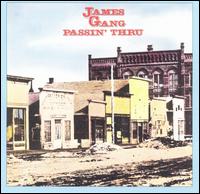 The
James Gang:
Passin' Thru (1972), **
The
James Gang:
Passin' Thru (1972), **
Enter the Era of Indifference. Another album of middling rock
with fairly dumb lyrics. Passin'
Thru has a whole lot of "hey, girl" songs matched to
vacant rock songs, either of the whiteboy funk genre ("One-Way Street",
"Up to Yourself") or ventures towards country/folk ("Run, Run, Run").
Give them credit for a few minor experiments which dead-end -
the folk + harpsichord on "Things I Want to Say to You"
(perhaps inspired by the Stones' "Lady Jane"), and some classical
guitar work both there and in "Drifting Girl". Kenner
is the sort of vocalist Jack Black honors (or parodies), with the big
tremeloed soul voice, tendency to jump into falsetto at the ends of
words, and sexy or dumb lyrics ("You're on a one-way street / a street
called life"). But
the band lacks
energy beyond Kenner's voice or their disciplined tempo, and they don't
excel with any of the influences they pull together. Troiano
melds into the rhythm section, and the session players are often the
most interesting things to hear (pedal steel on "Run, Run, Run" or
keyboards more frequently). The flipside is that nothing
here is really offensive or discouraging, in keeping with the mostly
sweet-talking lyrics. Only a couple tracks are sort-of worth
it - "Everybody Needs a Hero" is a decent song in the
non-balls rock category, and "Run, Run, Run" is fine country-rock.
Self-produced with Keith Olsen. Troiano left after
this
album to go solo and play with the Guess Who, who also released a pile of
forgotten 70s albums.
 Domenic
Troiano
(1972), ***
Domenic
Troiano
(1972), ***
If you want to own one early 70s
Canadian singer-songwriter / funk-rock record, this is probably the one.
On James Gang (and Mandala)
records, it's tough to
discern Troiano's personality, as he's always coupled with Roy Kenner.
(In contrast, Walsh always comes across as a goofball, but
one with a
distinct musical voice.) Troiano's solo debut allows him to
display himself - his voice (surprisingly good) and his guitar work
(also good). Musically, this is busy funk/soul mixed with
more singer-songwriter material. The whole axis of sound is different from his James Gang
work, where all the musical instruments often had to fight Roy Kenner's
voice. Funky rock requires an excellent rhythm section, and
his was one of the best: Pentti
Glan and Prakash John, who are amazing and energetic, without
distracting from Troiano himself. The best demonstration of the boisterous funk is the opener "The
Writings on the Wall". It segways
into the equally good "The Answer" which has a similar sound, except
that Troiano's solo draws more from jazz or classical music than his
work with the James Gang would suggest. But one thing that
comes across is that these songs are predominantly more personal than
Gang material. Troiano's baritone voice sounds like the
best of any James Gang guitarist, and most of these songs would suffer
from the Roy Kenner Experience. He does drift into mellow
patches ("Repossession Blues" "I Just Lost a Friend") or reminiscence
("Let Me Go Back") but never mires himself in James Taylor territory.
The worst track is the obvious one: the downer joke
"Hi Again" where Kenner lends his bombast for the lead vocal.
Overall, Domenic
Troiano is really a surprise. Although I doubt
early-70s Canadian funk-rock is going to have a revival, this cannot be
a bad place to look, with tracks like "The Writings on the Wall", "The
Answer" or "The Wear and the Tear on My Mind". Glen and
John, had been in Bush with Troiano earlier, and later worked
with Lou
Reed and Alice Cooper for a number of years. Other backing
players include Hugh Sullivan
and Red Rhodes. Produced by
Troiano and Keith Olsen.
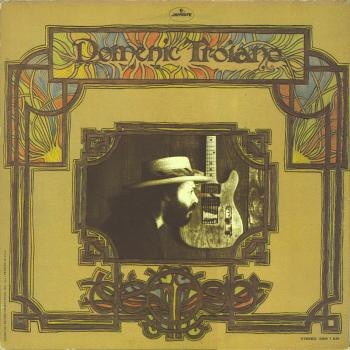
Fun fact: the cover
is mostly hand drawn and spells some things wrong.
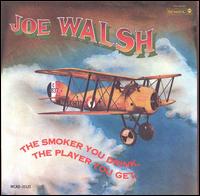 Joe
Walsh: The Smoker You Drink, The Player You Get (1973),
***1/2
Joe
Walsh: The Smoker You Drink, The Player You Get (1973),
***1/2
This
is strongest of his three pre-Eagles solo albums. The sound
is more focused than Barnstorm
- Walsh retained much of the mellow feeling, but cut out a lot of
instrumental dead weight and used spiffy, mainstream
production. It doesn't start so laid-back, however, as the
opening track, "Rocky
Mountain Way"
is classic Walsh - stinging slide leads, his goofy sense of
humor
in the lyrics, with a lengthy
talkbox solo. The album then backs off; the remainder loaded
with subdued keyboard or acoustic guitar-led
pop songs. The entire band (including new keyboardist Rocke
Grace) contributed songs, and most of the best material was written by
the others - Vitale's gentle psychedelia ("Bookends") or Chicago-style
light jazz/pop ("Days Gone By" complete with flute),
Passarelli's Caribbean jams ("Happy Ways"), along with Walsh's own
folkier "Meadows" and "Wolf". The
production is rather extensive, and with a pile of keyboards, it almost
has the feel of a Todd Rundgren album from this era.
At its
worst, it's mired in 70s tropes (Grace's "Midnight Moodies" is a
tosser: flute and synthesizer to light jazz), but mainly Smoker is sonic
comfort food. Szymczyk
and Walsh produced.
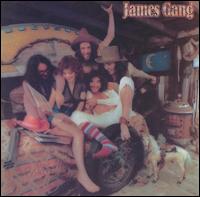 The
James Gang: Bang
(1973), **1/2
The
James Gang: Bang
(1973), **1/2
Once
again the Gang
has a new guitarist who kicks some life into them.
The six-shooter this time is Tommy Bolin, whose work is more arena-rock
oriented than his earlier blues/jazz work with Zephyr and Billy Cobham.
Bang
is really his album - he and some outside folks wrote almost all of the
material. Where Troiano was a
bland leading man, Bolin tackles a wider range or styles and tones,
usually overdubbing himself to add depth. The
band's sound is roughly the same - Roy Kenner's overdone Jack
Black soul vocals ("The Devil is Singing Our Song" is the best
example), nods to country, funk, power chords, soft rock everything.
Consciously or not, Bolin emulates Walsh's grab-bag approach
in terms of influences, and guitar sounds. So when the album
opens with cranked power chords on "Standing in the Rain" and Bolin
breaks out the slide, you can trick yourself into thinking something of
the old James Gang is back. While Bolin was a good
guitarist, all
the phasing,
coked-out blues, and minor experiments like the blues/funk/50s rock on
"Must Be Love" or minor synthesizer use on "Ride the Wind" anchor the
album to mid-70s rock malaise. (The cover art's color palette
tells all). Even a track like Kenner's a
capella overdub "Rather Be Alone With You" is more an oddity than a
destination. Nor are the lyrics special, mostly men
singing
about women, in a less obnoxious way than Bolin's next stop.
For
every track like "Standing in the Rain" or
the lively funk of "From Another Time" which is the album's other good
track, there are listless (or to be polite, relaxed) songs like
ythe Bolin-sung "Alexis" which verges on soft rock or "Mystery" which
tries to
recapture the grandiosity of "Ashes,
the Rain
&
I" (but somehow gets Kenner to turn it down). Bolin's guitar
work is good, and Fox does shine in places, but the songs are middling
and the production slightly oily. A branch of rock probably
never to be
resurrected. Self-produced.
Two
stray comments. First, they already took the cover photo and
Bolin had to be airbrushed in. Second, I bet Bolin had to
learn
some of the old Walsh and Troiano material for shows. That
must
get obnoxious after a while; think of the guys joining the band
post-Bolin.
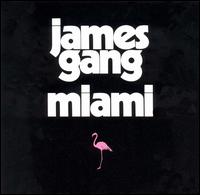 The
James Gang: Miami (1974), **
The
James Gang: Miami (1974), **
An
ominous beginning: hearing the opening
chords and they sound exactly like another song. "Cruisin
Down The Highway" is the same as Traffic's "You Can All
Join In" (minus
the sax squiggles), which opens Traffic.
For Bolin's second album, the Gang was now a slick hard
rock machine. Kenner's shtick
has gone so downhill that on Miami
he is as forgettable as most of the songs on the record.
Beyond being slick, Miami
is
also boring. The first three songs have the exact same
structure
and
sound (mid-tempo rock). The next (fourth) differs slightly
but
still has an apt title, "Sleepwalker". Not only does
this reflect the listener, it is as if Bolin was merely content to
vaguely imitate Walsh with crunching chords and slide guitar.
The only good song on this side sounds is a short instrumental that
sounds like the Motel 6 theme ("Miami Two-Step"). The
back side is better with Bolin playing light jazz twitterings, which
builds into a decent (but not good) rock song ("Praylude / Red
Skies"). The only song with sincerity is Bolin's
ballad "Spanish Lover", which has a nice acoustic base, and
Bolin on vocals. The rest, forget it. Not as bad as
the
mechanical first three songs, but nothing notable.
If this is what regular rock was doing in the mid-70s, no wonder metal
and prog ruled the day. Bolin quit, and the band imploded; he
later recorded a pair of solo albums and joined the rump of Deep Purple.
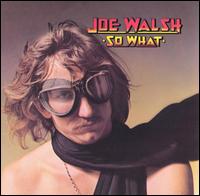 Joe
Walsh: So What
(1975), **1/2
Joe
Walsh: So What
(1975), **1/2
This
is probably Walsh's first true solo album, and it has a bit too
much Walsh. Joe replaced his Barnstormers with
session men or self-overdubs (Vitale shows up a few places), and dumped
the keyboard
palette for his guitar. Hooray, the rockists will say, but
his rock songs are half-empty arena-sized tunes with jokey humor
("Welcome to the Club", "Time Out", the gauzy "County Fair"), although
he has good version of the old James Gang tune "Turn to
Stone" . The other thread is mellow 70s rock-folk
("Falling Down", "Help Me Through the Night") usually with backing
vocals from the Eagles. Yet, for all the rote,
mid-70s tropes, Walsh is so idiosyncratic the album has both a Rick
Wakeman-like synthesized version of a classical piece ("Pavane"), and a brief
goof-off blues piece ("All Night Laudry Mat Blues").
Walsh and John Stronach produced, largely
continuing Szymczyk's
deep production sound, although Szymczyk
has one appearance - the album closing "Song for Emma" - a piano ballad
larded with strings and female backing vocals, perhaps in an attempt to
repeat "Ashes, the Rain & I". Shortly after this
album came out, Walsh joined the Eagles.
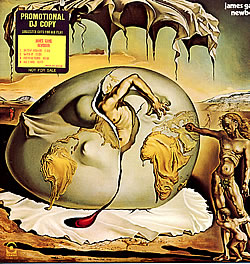 The
James Gang:
Newborn (1975), *1/2
The
James Gang:
Newborn (1975), *1/2
The Gang
must have really screwed up their karma, because they keep
reincarnating in a worse format. By this time, they were
essentially a bar band with a very good drummer, and production from
heavyweight Tom Dowd. Fox and Keith: Rhythm Section for Hire,
teamed up with Bubba Keith (vocals, some guitar) and Richard Shack
(lead guitar). (That's right, Dick Shack and Bubba Keith).
Keith was more Kenner than Walsh in his vocal
approach, but while Kenner always sounded like he sweet-talking the
ladies, Keith is more about dread and drinking. Keith and
Shack
wrote almost all of the songs on Newborn,
but the approach is largely
the same as the band's last few albums, even if the duo cranked up the
crunching guitars.
Mostly harder rock songs, loud
guitars and a large, large pile of lyrical clichés. Keith even
sings "good loves goin' bad" at one point, alongside other songs
concerning love, hellraising or both ("Earthshaker"). There
are a few boring ballads to
even things out ("Come With Me" is a wanna-be film theme) and a fair
country-rock song at the end ("Cold Wind"), but mostly loud
forget-me-rock. Shack was
the weakest lead guitar player yet, but
sometimes the crunching guitars snag hold of some melody and the result
isn't so bad, such as on the album's best tracks: "Shoulda Seen Your
Face" and "Red Satin Lover". 1975 was not a great time for
main-line
rock, and this is another example of why. Oh, the non Shack
and/or Keith track? A cover of "Heartbreak Hotel".
Inessential, unless you're one of those who goes around
digging
up Heartsfield albums as well. Shack was an old Cleveland
guy, and I believe he and Keith played together before and/or after in
a totally forgotten band called L.A.P.D.
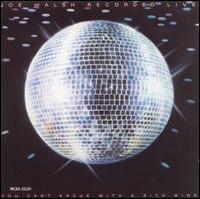 Joe
Walsh: You Can't Argue With a Sick Mind (1976)
Joe
Walsh: You Can't Argue With a Sick Mind (1976)
A
live album in which he runs through some hits from the James Gang and
his solo career. Nothing really exciting here, and his voice
is
terribly whiny in concert.
The best song is, surprisingly, So
What's "Help Me Through The Night", where is he
isn't trying to be slick. Otherwise the renditions of both
"Rocky Mountain Way" and "Turn to Stone" don't
really go anywhere. The songs that I know sound better in the
studio. I don't know what his backing band was at this point,
but there's a second guitarist and I bet Joe Vitale is there as
well. Avoid if you can help it.
The James Gang: Jesse
Come Home
(1976)
Forget
Jesse, how about Joe come home?
Just
turn your
pretty head and walk away to the Music page...